Posts tagged ‘wine’

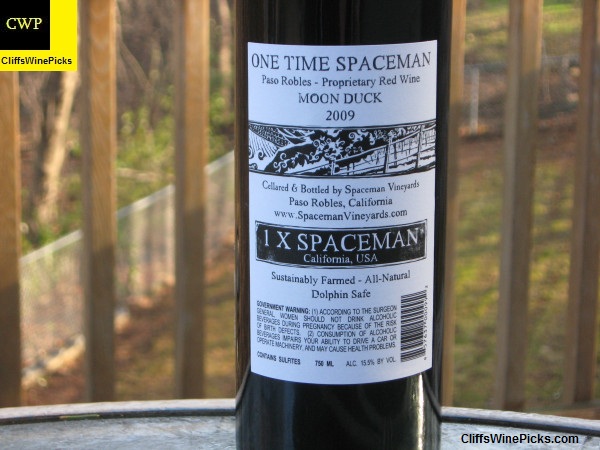
2009 One Time Spaceman Moon Duck


This is based on a sample supplied to me by the winery


This is your chance to get in on the ground floor of what may be the next big thing to come out of Paso Robles.  I’ve been a big fan of Mark Adams’ wines for a couple years and they are getting better every vintage.  Between this label, One Time Spaceman, and his other label (with his wife) Ledge, he is just one big score from one of the major wine publications from being a rock star.  Well, his music is very good, but in this case, I’m talking about a wine making rock star.  Jump aboard before this is another one of those wines that is unobtainable, ala Saxum, Carlisle, SQN…etc.


The One Time Spaceman wines are available mainly via the retail chain, but I highly recommend checking out Ledge and getting in on the mailing list.


Check out Ledge at:

http://ledgevineyards.com/index.php


More information on the One Time Spaceman wines is available at:

http://spacemanvineyards.com


2009 One Time Spaceman Moon Duck – SRP $28.99


My comments

The illustrious winemaker/rocker for this is Mark Adams.  This is just one of the many hats worn by Mark.  For those in Paso Robles, he is equally well know for his music.


The Moon duck is a blend of Mourvedre, Syrah, Grenache blend with a splash of Tempranillo, all from small vineyards in the Paso Robles area.  The wine was aged in 100% oak, 50% new French oak, the remainder in neutral oak barriques.  The alcohol is a very well hidden 15.5%, which surprised me, it doesn’t show any heat nor does it show any overly ripe notes.


If you’re into scores, Steve Tanzer’s International Wine Cellar gave the previous vintage 90 points.  The current release of Mark’s 2010 Ledge Syrah Adams Ranch Vineyard just received a stellar 92 score from IWC.  It is my understanding, the 2010 Ledge is in short supply and I’d recommend checking them out at http://ledgevineyards.com/index.php.  I can say this since I put my money where my mouth is by grabbing a 6 pack when it was released.


Winery Tasting Note (Gotta love it)

This wine is a complex, fruit forward GSM Rhone blend crafted in the style that has made Paso Robles famous.  Aged in both new and neutral French oak this wine is out of this world.  The color of this wine is reminiscent of a Red Giant Star in its last phase.  On the nose it shows explosive Astro Berry, Plasma Spice and Cosmic Flower.  On the palate the bright arrogant fruit is held together perfectly by complex Interstellar Dust and a rich Nebula Core.  One Time Spaceman wines are unique, dramatic and boutique blends from some of the best sites in Paso Robles.  Each one is different, produced in small lots and represents an opportunity to try cult wines without the cult wine price.  Get it now before it is gone!  Appellation: Paso Robles  Production: 644 cases


My Tasting Note

The wine is a deep maroon color.  The very inviting nose features blackberries, dark chocolate, fresh ground espresso, earthy underbrush, baking spices, cherries and dried herbs.  This has medium to full body, solid, ripe tannins, and very good acidity.  On the palate the wine shows spicy, earthy fruit up front with dried herbs, chocolate, and espresso in the background adding considerable depth.  The finish is fairly long with dark chocolate and espresso melding nicely with the spicy berries.  This is still very young and some cellar time will be greatly rewarded.  (92 pts)


You have to love the fact the wine is 100% Dolphin Safe:


It may not be Rosé weather right now in a lot of the country, but I have had several bottles of the 2011 One Time Spaceman MCA Rosé and it was a very nice fruity wine.  There are a couple reviews of the wine in other postings here.


An example of some of Mark’s music:

http://www.markadamsusa.com/wp-content/uploads/2012/03/1.-Bus-Argument-final1.mp3


More music selections and additional information available at:

http://www.markadamsusa.com/


Remember to support your local wine store!


* * * * * * * * * * * * *


Notes – I use the “official” Cellar Tracker name for the wines.  I use Cellar Tracker to help manage and organize my cellar.  I highly recommend checking it out at www.cellartracker.com.  Loading you existing cellar is a lot less intimidating than it would first appear.  There is a good chance 99% of your wine is already in the system, so you generally only need to enter part of the wine’s name and the system will find it for you.


Prices noted are the prices I paid at the time of purchase.  I don’t shop around to find the best prices, but my local store is usually VERY competitive.  I generally get case discounts, and since I work there part time, I get a 5% discount.  Wines purchased direct from a winery do not include any shipping charges.  None of the prices include the sales tax.


All wines that were sent to me free of charge to sample will be noted and I will show suggested prices when available.


Cheers!


Nov 16, 2012 to Nov 18, 2012


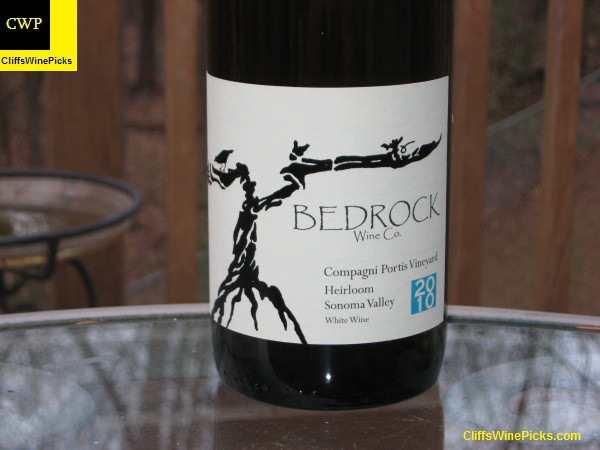
2010 Bedrock Wine Co. Heirloom Compagni Portis – $24.00


My comments

This wine is a field blend consisting of about a dozen different varietals from a vineyard planted in 1954.  This is how wines used to be made before people wanted to see a specific grape on the label.


I joined the Bedrock mailing list to get my hands on their red wines, but with every bottle of white wine I open, I am more convinced they are making some of the best white wines coming out of California.


Winery history

In 2009 I took this vineyard not really knowing what to expect.  Yes, I had tried the excellent wines made by my friend Will Bucklin, and  yes, I was besotted (as I often am by plants from California’s viticultural antiquity) with the nearly 60-year-old, dry-farmed, vines of varieties of many different hues and shades:  However, I was not expecting to fall in love.  For me, the odd combination of field-blended whites yields a wine that offers a glimpse at the white wines of yore in California.  Rose, lychee, and spice come from the Gewurtzraminer, while brightness and enough backbone are given by the Trousseau Gris, Riesling, Berger, Green Hungarian, and whatever else is out there.  For me it has exactly what I am looking for when it comes to an heirloom wine — it is a sporadic, seemingly random, assemblage of varieties that can only be found together here in California’s oldest vineyards and makes a wine more indicative of place than variety, spacing, farming, or anything else.   That said, farming is important, and this winter I decided, as many men do when their emotions get in the way of their better senses, to lavish the vineyard with some viticultural bling.  Decades of minimal farming (and who can farm when getting $1200 a ton!) had rendered a vineyard full of blackberries and poison oak, dead vine limbs fraught with eutypa and bot canker, missing vine positions, and limited vigor.  This winter vineyard manager Phil Coturri, the Compagni Portis family, and I, started a rejuvenation project.  Gone are the blackberries and poison oak stealing the vines water and causing pricks and rashes.  A pyre of the fungus ridden vine arms slowly killing the plants was set ablaze.  In their stead are a set of new wires, a full conversion to cane pruning to increase the number of spur positions and potential clusters (I love concentrated fruit but .9 tons per acre is simply economically unsustainable), and in the fall the first set of cover crops will be put down to add nutrients back to soil and increase friability and tilth.  What does this mean?  It means that Bedrock dropped some serious coin, but that we have taken the first step in making sure the vineyard will be around for another sixty years.  I say this as preamble to the raise in price from $20 to $24 dollars per bottle for the wine so you will know that I am not simply trying to line my pockets — in reality, selling all six barrels of the wine at this new price will only pay for half of the improvements.  Rather, I am hoping you will be willing to join me in preserving this one-of-a-kind vineyard from a bygone age.  As for the winemaking, this is a vineyard where I believe simplicity is key.  The wine was whole-cluster pressed and then fermented in stainless-steel and neutral oak barrels with native yeasts.  The richness of fruit and spice in 2010 prompted me to halt malolactic conversion to retain brightness to leaven the opulence of the fruit.  I am unquestionably pleased with the results.  Six barrels produced.


My Tasting Note

The wine is a bright golden yellow color.  The wine has an outstanding nose with beeswax, fresh flowers, peaches, apples, pineapple, flint, stony minerals, and spices.  This has light to medium body with crisp acidity.  On the palate the wine displays layers of fruit and spice with some nice minerality in the background adding considerable depth.  There is a long, lingering, flavor filled finish.  This is an outstanding effort and a big bargain at $24.  (92 pts)


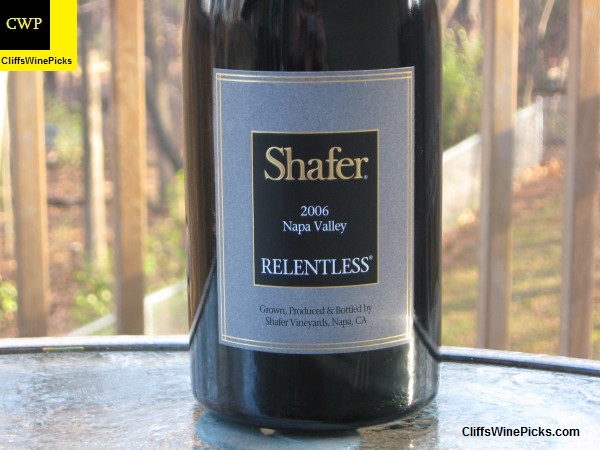
2006 Shafer Relentless – $42.74


My comments

I decided to open a Relentless to honor the fact the 2008 vintage of this wine was named Wine Spectator’s Wine of the Year.  I had a bottle about a year and a half ago just to check it out before giving it some cellar time.  I’ll probably open a bottle every year and a half over the next several years.


Winery history

Shafer Vineyards traces its beginnings to 1972 when John Shafer left a 23-year career in the publishing industry and, with his family, moved to the NapaValley to pursue a second career in wine.  After purchasing a 210-acre estate in NapaValley’s Stags Leap District, the Shafer family faced the arduous task of replanting the existing vineyards, which dated to the 1920s, and terracing the steep and rocky hillsides, eventually expanding vineyard acreage to its current 50 acres.


Evolving from grape growers to vintners, the Shafers crushed their first Cabernet grapes in 1978 and began construction on their winery a year later.


The first Shafer Cabernet became a benchmark, winning the acclaimed San Francisco Vintners Club taste-off upon release and, over a decade later taking first place in an international blind tasting held in Germany, where it outranked such wines as Chateau Margaux, Chateau Latour and Chateau Palmer.


Doug Shafer became winemaker in 1983 after graduating from the University of California at Davis with a degree in enology and viticulture.  A year later Elias Fernandez joined the winery as assistant winemaker.  Together Doug and Elias have worked closely to forge the Shafer style of quality, consistency and elegance.


New vineyards have been added over the years, with acreage acquired in the Oak Knoll, Stags Leap and Carneros districts, bringing the total Shafer vineyard acreage to over 200 acres.  Winery facilities have been expanded and extensive caves carved into the hillside for aging wine.


In 1994, Elias was appointed winemaker, and Doug took over the reins as president when John became chairman of the board.


From a modest beginning of 1,000 cases in 1978, the winery has grown steadily until reaching its present size of 32,000 cases of Cabernet Sauvignon, Merlot, Chardonnay, and Syrah.  Today Shafer wines are available in major markets nationwide and in many foreign markets.


My Tasting Note

The wine is a deep, dark, inky purple color.  The exotic and enticing nose has blackberries, fresh ground dark roasted coffee beans, dark chocolate, melted licorice, black pepper, smoke, black cherries, tar, and violets.  This is full bodied with solid, ripe tannins and good acidity.  On the palate there are layers of fruit and savory elements that thoroughly coat your  mouth.  The finish is fairly long and again is loaded with flavor.  Not a lot of subtlety here, just massive amounts of flavor, that are held in check by the outstanding tannic backbone and acidity.  (93 pts)


2005 Meritxell Palleja Priorat Nita – $16.74


My comments

I’ve been a big fan of the rugged, rough and tumble wines coming out of the Priorat for a number of years.  Generally these are not fruit forward wines, in a lot of cases they aren’t even fruit driven.  These are generally loaded with spice, dried herbs, minerals, and earthy elements.


Winery history

Following the family tradition, Meritxell Pallejà started off in the world of viticulture by studying oenology and assisting at wineries both in the region (Vilella de la Cartoixa, the Cooperativa Agrícola de Capçanes and Álvaro Palacios) and also in the Napa Valley and the French Burgundy (on that occasion at a biodynamic winery that would influence her own way of working).  NITA is her first wine (brought out in 2004 and called Cal Nita, named after her grandmother’s house in Falset).  It saw the beginnings of her biodynamic project that takes into account the lunar calendar not only in the production process but also in recommending the most opportune moment for drinking the wine.


The lunar calendar shows the relationship between various activities, such as the grape harvest, racking, bottling and even trying and tasting the wine, and the differing positions of the sun, planets, constellations and signs of the zodiac.  This means that it can be ascertained when wines are at a more or less active stage (a waxing or waning moon) or how a plant’s general health is being affected, which will come through in changes to colour, potency of aromas, flavours and essential properties.  For example, the wine will display its floral and fruity attributes to better effect if we drink it on “flower” or “fruit” days on the lunar calendar, and that is precisely when Meritxell suggests we open a bottle of her Nita.


My Tasting Note

The wine is a ruby red color, much lighter at the edge.  The old school nose features crushed rocks, blackberries, scorched earth, dried herbs, licorice, leather, tobacco, underbrush, and dried flowers.  This has medium body with sold tannins and very good acidity.  On the palate the initial fruitiness is quickly brushed out of the way by solid minerality, dried herbs, and earthy elements.  The long finish leans on the savory elements with the fruit in the background.  The finish is like a mouthful of crushed stones and dried herbs with one solitary blackberry providing some sweetness.  This is still on the young side but if you don’t mind solid tannins, it’s in a great place right now.  (92 pts)


2004 Adriano Marco e Vittorio Barbaresco Basarin – $34.80


My comments

I’ve had three bottles of this wine in the cellar for close to 4 years.  Every time I check my inventory for an Italian wine, this is the first wine I see, since my inventory is sorted in alphabetical order on the wine name.  It’s probably still on the young side, but it’s time to check in to see how the wine is coming along.


Winery history

The Azienda Agricola Adriano Marco e Vittorio farm is located in the heart of the Langhe, at Frazione San Rocco Seno d’Elvio, over the beautiful Alba, producing wines with the unique characteristics of the territory. It is a family run company, who has been producing wine from its own grapes for generations. At the beginning of the 20th century, Giuseppe, the grandfather, who was share-farmer, started his activity of growing grapes. Later on, he purchased a small farm and together with his son Aldo, expanded the family property planting new vines. The grandsons, Marco e Vittorio, continued this expansion, introducing big changes as the wine-making and the bottling of their own production. The farm has currently an extension of 22 hectares of vineyards of NEBBIOLO for BARBARESCO, BARBERA, DOLCETTO, FREISA, SAUVIGNON and MOSCATO; 8 hectares are dedicated to the hazelnuts, typical from the Langhe region and 10 hectares are divided in meadows, fallow land and forests where the famous White Truffle from Alba can be found.


My Tasting Note

The wine is a medium to dark ruby red color.  The very enticing nose has cherries, earthy underbrush, baking spices, fresh ground espresso, dark chocolate, dried herbs, and fresh flowers.  This had medium body with fairly solid tannins and very nice acidity.  On the palate the earthy, savory notes command center stage with dried herbs and fruit on the sidelines.  The finish has nice length and again highlights the savory elements.  This is still very young but tasty.  (90 pts)


Mailing Lists

Getting a few random offers with Holiday offers, mainly for wines I either already have or passed on earlier.


Wines bought or received this week

It was a busy receiving week.


From Garagiste

(6) 2005 Frenchman Hills Red Wine Sentinel Gap Vineyards

(6) 2001 Weinhofgut Anton Zimmermann Bernkastel-Kueser Weisenstein Riesling Auslese

(6) 1998 Weinhofgut Anton Zimmermann Bernkastel-Kueser Weisenstein Riesling Auslese

(3) 2010 Domaine du Colombier Crozes-Hermitage


From Loring

(4) 2011 LoringWineCompanyPinotNoirRussianRiverValley

(4) 2011 Loring Wine Company Pinot NoirSantaLuciaHighlands

(4) 2011 LoringWineCompanyPinotNoirStaRitaHills

(3) 2011 Loring Wine Company Pinot Noir Rosella’s Vineyard

(3) 2011 Loring Wine Company Pinot Noir Keefer Ranch Vineyard (375 ml)

(6) 2011 Loring Wine Company Pinot Noir Garys’ Vineyard (375 ml)


Remember to support your local wine store!


* * * * * * * * * * * * *


Notes – I use the “official” Cellar Tracker name for the wines.  I use Cellar Tracker to help manage and organize my cellar.  I highly recommend checking it out at www.cellartracker.com.  Loading you existing cellar is a lot less intimidating than it would first appear.  There is a good chance 99% of your wine is already in the system, so you generally only need to enter part of the wine’s name and the system will find it for you.


Prices noted are the prices I paid at the time of purchase.  I don’t shop around to find the best prices, but my local store is usually VERY competitive.  I generally get case discounts, and since I work there part time, I get a 5% discount.  Wines purchased direct from a winery do not include any shipping charges.  None of the prices include the sales tax.


All wines that were sent to me free of charge to sample will be noted and I will show suggested prices when available.


Cheers!


Nov 12, 2012 to Nov 15, 2012


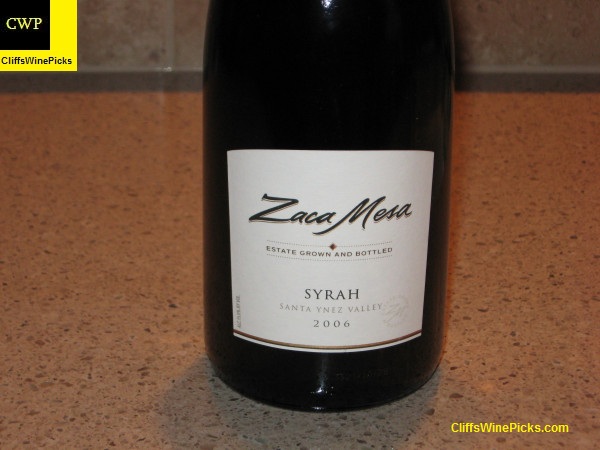
2006 Zaca Mesa Syrah – $15.67


My comments

This is generally a good California Syrah at a wallet friendly price.  In some vintages it seems to have that little something extra that propels it to the next level.  In my opinion, 2006 was one of those years.  I bought a half case of this from my local store and after killing two bottles fairly quickly, I’ve been showing some unusual restraint.  Even with the restraint, I’ll only have one bottle left after popping this one.  I have the 2007 in the cellar, but based on the one bottle I had upon release, it dropped back into the merely good category.


Winery history

The original property was purchased in 1972 by a group of friends and they started planting the vineyard in 1973.  With few other vineyards in the area to learn from, the vineyard was originally planted with numerous varieties such as Cabernet Sauvignon, Merlot, Zinfandel, Riesling, Pinot Noir, Sauvignon Blanc, Chenin Blanc, Grenache, Chardonnay, and Syrah to see what would work.


As the vineyard came into production, a winery was built on the property in 1978 and later expanded in 1981.  1978 was another milestone for Zaca Mesa, planting the first Syrah in Santa BarbaraCounty.


By the early-1990’s, we had determined based on our farming experience that the Rhône varieties (Syrah, Grenache, Mourvèdre, Viognier, and Roussanne) grew best on our property.


As one of the pioneers in the Santa BarbaraCounty, Zaca Mesa was a training ground for many.  Ken Brown was our first winemaker and later started Byron in Santa MariaValley.  Adam Tolmach, Jim Clendenen and Bob Lindquist worked at Zaca Mesa before venturing out on their own to start Ojai, Au Bon Climat and Qupé, respectively.


Zaca Mesa was the first CentralCoast winery to appear in Wine Spectator’s Top 10 back in 1995.  A year later, our Syrah was served by President Clinton to French President Jacque Chirac at a White House State Dinner.  To show that we are not leaning one direction, our wines were also served at President Reagan’s 80th birthday party at the Beverly Hilton.


Since 1997, we have focused on growing the best Syrah, Viognier, and other Rhône varieties.  We have ripped up over half the original vines, replacing them with high-density planting of new rootstock and clone combinations that has significantly improved our quality.  We now have 9 clones of syrah and the most high density vineyard acres in the county.


Over time the ownership group diminished to one of the original partners. Zaca Mesa has been family owned for almost 25 years.


My Tasting Note

The wine is a deep, dark maroon color.  The outstanding nose has blackberries, licorice, smoked meat, black pepper, vanilla, plums, violets, dried herbs, and a bit of dark chocolate.  This is fairly full bodied with solid tannins and very nice acidity.  On the palate the peppery berries lead the way with some chocolaty oak and dried herbs in the background adding depth and complexity.  The finish features nice fruit leading to dark chocolate and dried herbs, but it could be a touch longer.  An outstanding week night Syrah for well under $20.  (90 pts)


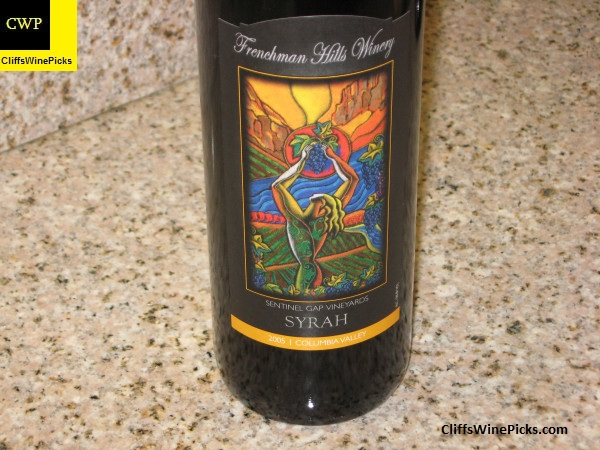
2005 Frenchman Hills Syrah Sentinel Gap Vineyards – $7.99


My comments

This was a blind purchase, which I usually avoid.  This was one of the infamous Garagiste Mystery Wines from an offer at the end of August.  For those keeping score, this was Mystery Wine #50, a Washington State Syrah for $7.99 a bottle.


My expectations were low, this was ordered just to fill one last case before shipping season.  After receiving the wine, my expectations were raised considerably.  The average price paid on CellarTracker was close to $30 and the two notes didn’t sound too bad.


Winery history

Not much information available on the internet about the winery.


My Tasting Note

The wine is a deep maroon color.  The nose is a bit shy but reveals blackberry, licorice, dried herbs, black pepper, and a touch of dark chocolate.  This has medium to full body with fairly solid tannins and very nice acidity.  Nice spicy, peppery berries greet the palate in a laid back style.  This is not a big, ripe, fruit forward, fruit bomb,  This is fairly elegant and nuanced, perfectly concealing its 15% alcohol.  The finish has nice length and shows a bit more fruit than the savory elements.  A solid bottle of wine for those who jumped on the Garagiste Mystery Wine offer.  A steal at $8.  (88 pts)


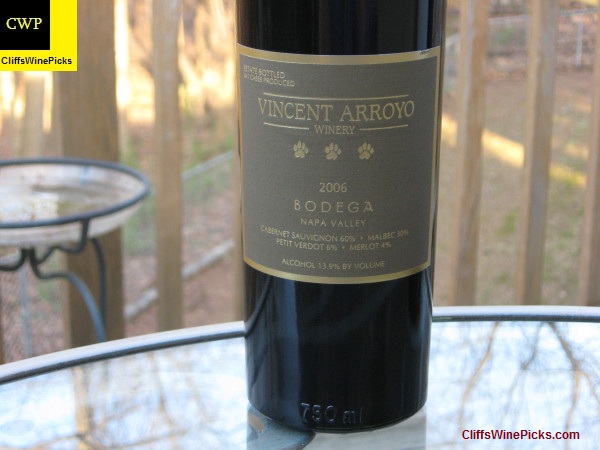
2006 Vincent Arroyo Bodega – $19.99


My comments

I’ve been a long time supporter and buyer of the wines from Vincent Arroyo.  This wine is a blend of 60% Cabernet Sauvignon, 30% Malbec, 6% Petit Verdot, and 4% Merlot.


Winery history

Walking into the Vincent Arroyo Winery, one gets the sense that it has been here forever.  Is it just the comfortable atmosphere of a big barn full of oak wine barrels that lends to the sense of permanence?  Vincent Arroyo, himself, may feel like he has been here forever, as well.  He left behind a career as a mechanical engineer in the Silicon Valley during the early 70’s and headed to Calistoga, at the northern tip of the NapaValley.  He felt much more at home close to the land, being able to see and taste the fruits of his labors.


The purchase of the 23 acres of the Greenwood Ranch property in 1974 began the evolution of what is seen today, 85 acres cultivating 9 different wine grape varietals.  Vince has always been a farmer at heart, taking care of the land to produce the best that it can.  He began to transform the Greenwood Ranch by ripping out existing prune trees and unhealthy vines and planting new vineyards.  For many years, he did it all alone, the tractor work, cellar work and a one-man sales force.  Originally he made just a few hundred cases of his favorites, Petite Sirah and Cabernet, selling the majority of the grape tonnage to other Napa wineries.  Today, he produces over 8,000 cases of seven different varietals.


The wines produced at the Vincent Arroyo Winery have put a star on many NapaValley maps as a place that shouldn’t be missed.  His signature wine, still Petite Sirah, has become so popular that it often sells out before it is bottled every year.  Once you have tasted the wines, you’ll know why.  The winery also makes a Chardonnay, Cabernet Sauvignon, Merlot, Sangiovese, Zinfandel and several red blends.


More information is available at http://www.vincentarroyo.com/


My Tasting Note

The wine is a medium to dark garnet color.  The very appealing nose features blackberries, baking spices, cedar, tobacco, cherry, vanilla, and a bit of earthiness.  This has medium body with fairly solid tannins and very nice acidity.  On the palate the spicy fruit hits first with some cedar and earthiness in the background adding depth.  The finish has nice length with cherries and spice carrying the load.  A very nice Bordeaux style blend from Napa.  (90 pts)


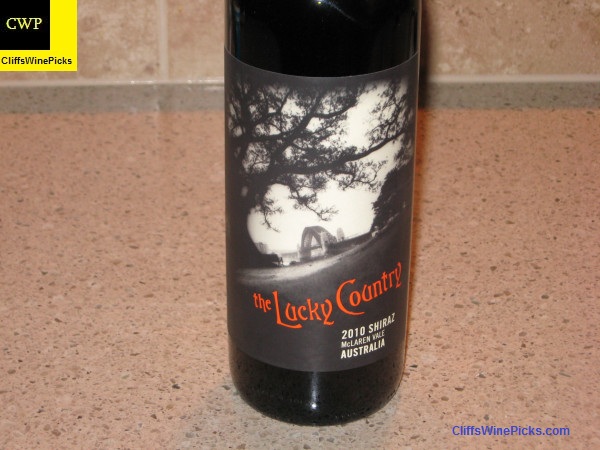
2010 The Lucky Country Shiraz – $9.90


My comments

It’s been a while since I opened a bottle of this wine.  I opened one not long after picking up a case at my local store.  The wine was decent, but seemed to be a bit below the previous vintage.  I felt a bit of cellar time should help the wine settle down a bit.  It’s time to check in to see how it is doing.  This is made by the team behind Two Hands, and the general thought is this is the declassified fruit from Two Hands.


Winery history

The Lucky Country Wines offers quality wines packaged with iconic Australian photography, representing the lively spirit of Australia.


The name is taken from the 1964 book, The Lucky Country, written by social critic Donald Horne and was originally written to be ironic, as an indictment of 1960’s Australia.  Donald believed that the economic success of 60’s Australia was derived from luck rather than skill.


But over the years, this phrase has taken on new meaning and is now proudly used by many to describe what is great about Australia.


The Lucky Country Wines is the result of hard work combined with vision, creative acumen and business ‘smarts’, and maybe just a little bit of luck to help bring it all together.  The wines are already proving a hit, available in several markets around the world and with the brand continuing to grow every day.


The Lucky Country Wines were created to deliver great value, stylish wines to drinkers at a reasonable price.  People everywhere can now share and enjoy the experience of what makes Australia the Lucky Country.


My Tasting Note

The wine is a deep purple color.  The very Australian nose features blackberries, blueberries, black pepper, vanilla, baking spices, and wild flowers.  This has a medium body with soft, ripe tannins and decent acidity.  On the palate the big fruit and peppery spice carries the load with a touch or chocolate and earthiness in the background.  The finish has decent length with sweet berries and spice.  This seems to carry a touch of residual sugar but not enough to really stick out.  This would be a nice holiday party wine.  (87 pts)


 Wines bought or received this week

It was a busy receiving week so far.  I received a couple cases from Garagiste and have a couple cases due in tomorrow from Loring.  I’ll list all the wines received in my weekend blog, to be posted on Sunday evening.


Remember to support your local wine store!


* * * * * * * * * * * * *


Notes – I use the “official” Cellar Tracker name for the wines.  I use Cellar Tracker to help manage and organize my cellar.  I highly recommend checking it out at www.cellartracker.com.  Loading you existing cellar is a lot less intimidating than it would first appear.  There is a good chance 99% of your wine is already in the system, so you generally only need to enter part of the wine’s name and the system will find it for you.


Prices noted are the prices I paid at the time of purchase.  I don’t shop around to find the best prices, but my local store is usually VERY competitive.  I generally get case discounts, and since I work there part time, I get a 5% discount.  Wines purchased direct from a winery do not include any shipping charges.  None of the prices include the sales tax.


All wines that were sent to me free of charge to sample will be noted and I will show suggested prices when available.


Cheers!


The Seeker Wines – Around the World in a bottle


These reviews are based on samples provided by the winery or an organization acting on their behalf.


Winery Information  (winery supplied)

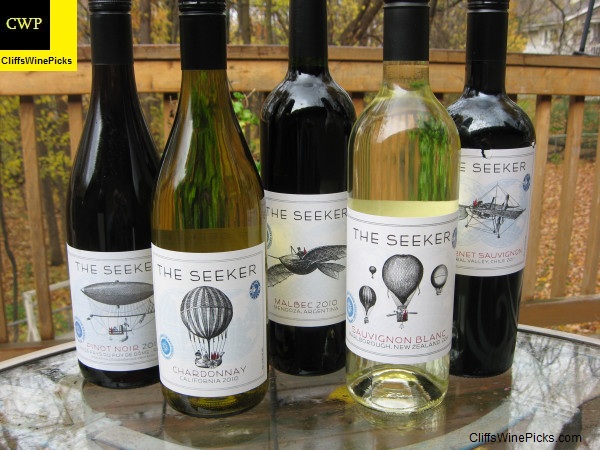
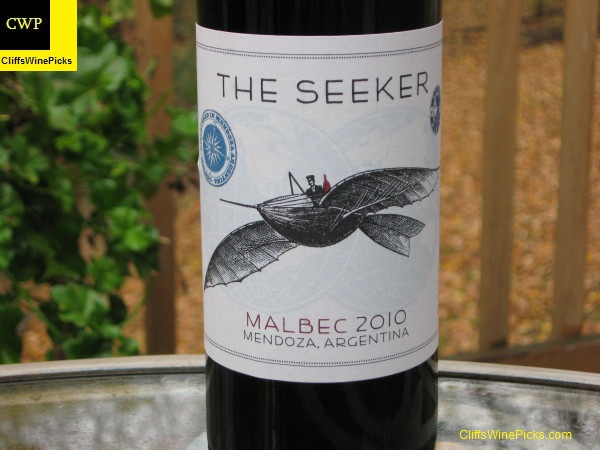
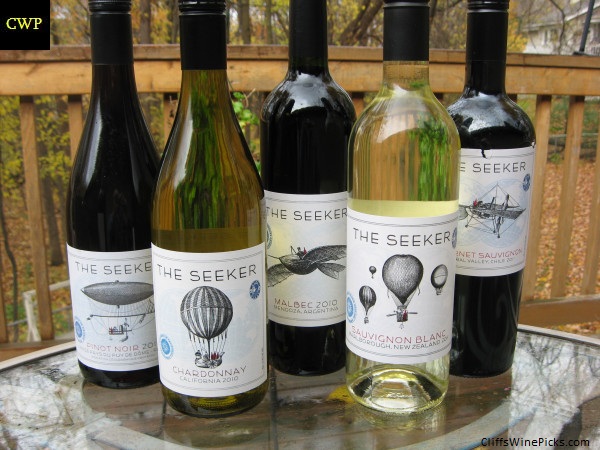
The Seeker Wines is a new line of carefully curated wines created for those who love to seek adventure.  Our wanderings yielded five unique varietals– a California Chardonnay, New Zealand Sauvignon Blanc, French Pinot Noir, Argentine Malbec, and Chilean Cabernet Sauvignon, each sourced from top-quality wineries celebrated for their excellence and dedication to sustainable practices and local printing.  Whether roaming far-off lands or exploring Facebook, Pinterest, and Twitter, The Seeker delights the senses on a global taste journey.  Just glance at the labels and you’ll see mid-19th century flying machines that beckon a bygone era of wonder and mystery that reminds us why exploring the unknown world is all about the journey.


The Seeker Wines were created by a family company that called on its 65+ years of experience to source from the best family-owned wineries in the world at an affordable price.  With a dedication to reducing our carbon footprint, The Seeker Wines extends our eco-friendly philosophy from our immediate family to our global family.  So whether by land, sea, or air, take flight with us and seek more information at http://theseekerwines.com


All wines have a suggested retail price of $10 to $15.


All wines were sampled over most of an evening.  This allowed me to capture each wine when it was at its peak.


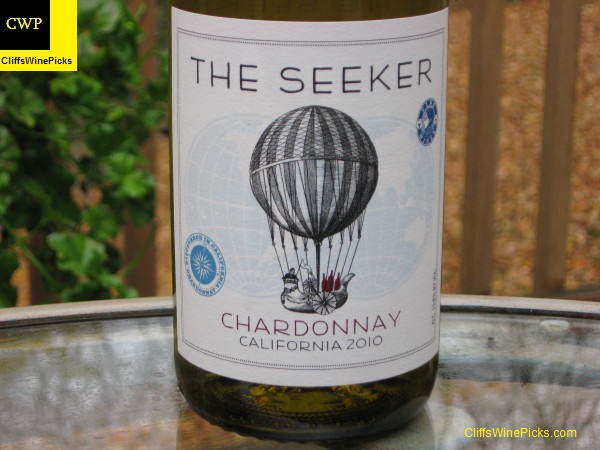
2010 The Seeker Chardonnay


My comments

The wine is 97% Chardonnay with 3% Gewürztraminer.  The grapes were sourced from cool climate vineyards in California.


The wine has 13.8% alcohol and was aged in tank on light lees with no oak.  A small portion under went malolactic fermentation, which adds a bit of creaminess and body to the wine.


This wine was produced in a state of the art, family owned winery utilizing solar and water conservation technology.


My Tasting Note

The wine is a light yellow to straw color.  The fresh nose features apples, pears, pineapples, lemon zest, minerals, fresh flowers, and spices.  This has medium body with decent acidity.  On the palate, the wine is fairly creamy and rich with the apples and pears upfront and pineapple and spices in the background.  On the backend, the wine turns a bit flat and loses a bit of focus.  On the finish a bit of citrusy acidity attempts to pull the wine back into focus and generally succeeds.  A slight herbal note lingers on the finish that could be useful in pairing the wine with food.  I would serve this well chilled to help preserve the acidity on the backend.  I think this would work well with a cool chicken salad with a bit of tarragon added just before serving.  (85 pts)


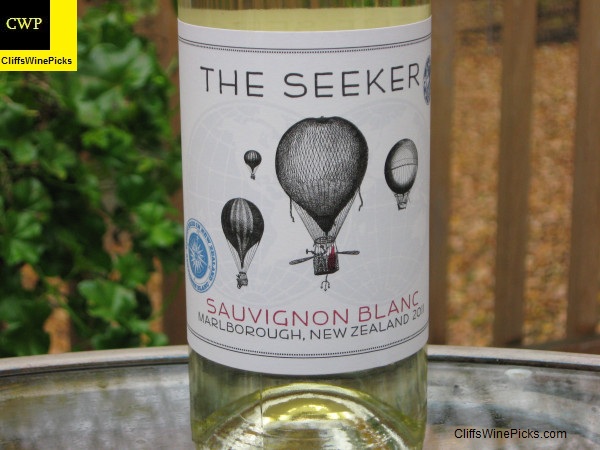
2011 The Seeker Sauvignon Blanc


My comments

The wine is 100% Sauvignon Blanc which was sourced from both Marlborough on the south island and Martinborough on the north island.


The wine has 12.7% alcohol and was aged 2 months in tank on light lees. After the aging, the lots were blended then gently fined and filtered before bottling.


My Tasting Note

The wine is a very light, clear, yellowish straw color.  The exotic, unusual, and appealing nose features musk laden apples, mint, lime, white pepper, saline minerality, and orange blossoms.  The wine has light body and features crisp, citrusy acidity.  On the palate the sweet, minty apples and spice get a boost when the lime kicks in.  The finish is fairly long with the saline laced minerals adding nice complexity.  This would be perfect with a relaxing dinner on the patio or deck with some grilled shellfish or a salad.  My vote would be to serve this with a shrimp salad served on a delicate, flaky croissant.  (90 pts)


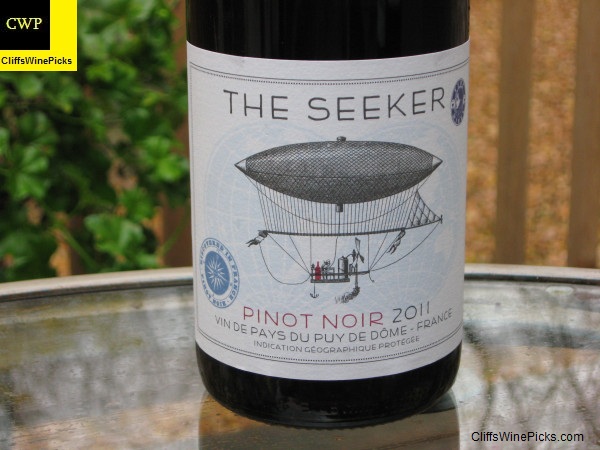
2011 The Seeker Pinot Noir


My comments

The wine is 100% Pinot Noir from vineyard sites in Auvergne.  The vineyards are on rich volcanic soils 350-500 meters above sea level.  The vines range in age from 15 to 40 years old.


The wine has an alcohol of 13.5% and was aged in tank on light lees with no oak.


My Tasting Note

The wine is a light, clear, ruby red color.  The light and fresh nose features cherries, Asian spices, raspberry, and some soft earthiness.  This is medium body, at most, with ripe tannins and very nice acidity.  On the palate the wine shows spicy, red fruit with a slowly building earthy element.  The finish is more on the earthy side with the red fruit and spice more in the background.  In my opinion, this was much better with some air.  The wine initially had candied red fruit front and center which was a bit distracting.  With the air the candied elements dissipated allowing the spice and earthiness to come through.  This would work well with chicken and pork dishes and may hold up well to a rich, creamy pasta dish.  My vote would be to give the wine an hour of air and serve with Fettuccine Alfredo with some sliced grilled chicken.   (87 pts)


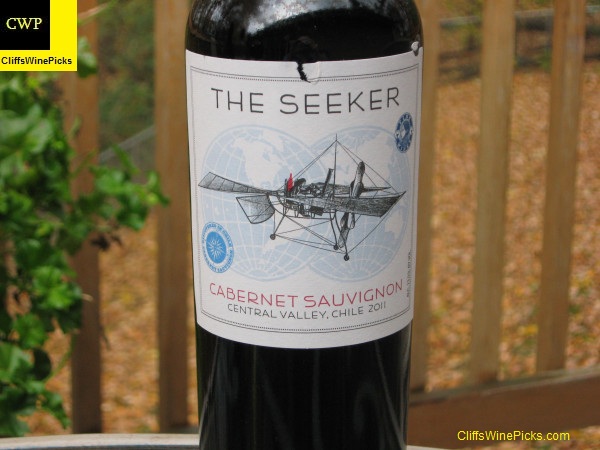
2011 The Seeker Cabernet Sauvignon


My comments

The wine is 100% Cabernet Sauvignon from vineyards in both the Maipo and Colchagua Valleys.  The vineyards are 17 years old and planted in clay and alluvial soils.


The wine has an alcohol level of 13.5%.  The wine was aged 5 months in 20% new oak.  The oak was 50% American and 50% French.


My Tasting Note

The wine is a medium ruby color.  The deep and dark nose features cassis, dark roasted coffee beans, smoke, dark chocolate, spices, dried herbs, vanilla, and some subtle earthiness.  This has medium body with fairly solid tannins and very nice acidity.  The upfront spicy and earthy cassis hits the palate first followed by some nice dark roast coffee and dark chocolate.  On the backend, as the fruit fades the earthiness takes over with a bit of dried herbs.  The finish has decent length but could use a touch more fleshiness.  This would be nice with a pot roast or beef stew.  My vote would be to serve with a medium rare sirloin steak that was seared to a nice charred exterior.  (88 pts)


2010 The Seeker Malbec


My comments

The wine is 85% Malbec with 10% Bonarda and 5% Cabernet Sauvignon.  The vineyards are Agrelo and Vistaflores in Lujan de Cuyo.


The wine has 14.5% alcohol and was aged for one year in French oak and a minimum of two months in bottle before release.


My Tasting Note

The wine is a deep, dark ruby to maroon color.  The very open and inviting nose features cherries, blackberries, licorice, Asian spices, earthy underbrush, mocha, and some violets.  This is medium to full bodied with fairly solid, ripe tannins and nice acidity.  On the palate the wine leads off with the spicy cherries and berries but the building mocha and earthy elements soon take center stage.  The earthy, dark chocolate flavors continue right through the finish, which has nice length.  This greatly improved with an hour of air, which helped it to add some weight and fill out the finish.  Serve this with something hot off the grill.  My recommendation would be a skirt steak with a bit of fine ground espresso added to the meat before a few minutes on a very hot grill.  (88 pts)


Contact information


More information can be found on the winery’s website at http://theseekerwines.com


You can follow the winery on Twitter at http://twitter.com/theseekerwines or check them out on Facebook at http://www.facebook.com/theseekerwines


Remember to support your local wine store!


* * * * * * * * * * * * *


Notes – I use the “official” Cellar Tracker name for the wines.  I use Cellar Tracker to help manage and organize my cellar.  I highly recommend checking it out at www.cellartracker.com.  Loading you existing cellar is a lot less intimidating than it would first appear.  There is a good chance 99% of your wine is already in the system, so you generally only need to enter part of the wine’s name and the system will find it for you.


Prices noted are the prices I paid at the time of purchase.  I don’t shop around to find the best prices, but my local store is usually VERY competitive.  I generally get case discounts, and since I work there part time, I get a 5% discount.  Wines purchased direct from a winery do not include any shipping charges.  None of the prices include the sales tax.


All wines that were sent to me free of charge to sample will be noted and I will show suggested prices when available.


Cheers!


Nov 5, 2012 to Nov 8, 2012


2008 Owen Roe Abbot’s Table – $19.99


My comments

I’ve had this wine a couple of times and always found it to be pretty good, but not that special.  I thought it may just have needed a bit more cellar time for it to fully open and express itself to the fullest.  It has been close to a year since I last visited the wine, time to see if the additional cellar time will be rewarded.


This is a bend of 24% Zinfandel, 22% Sangiovese, 15% Cabernet Sauvignon, 12% Syrah, 10% Merlot, 7% Cabernet Franc, 6% Blaufrankish, and 4% Malbec.


Winery history

There’s really no Oregon wine quite like Owen Roe “the Abbot’s”.  A blend of five different red wine grapes, it’s a conversation starter.  Five distinctly different wines blended together make the scent and flavor like nothing else around.  It makes people curious and then wins them over.  For an intriguing, delicious wine made from unusual blends of varietals, look no further than Abbot’s Table.


“Abbot’s Table is a wine for all occasions and all people” says Owen Roe winemaker David O’Reilly.


My Tasting Note

The wine is a medium to dark ruby color.  The very interesting nose has cherries, minerals, earth, licorice, underbrush, blackberries, black pepper, vanilla, violets, and a faint herbal note.  This has medium body with soft tannins and very nice acidity.  The civilized and food friendly palate has a nice mix of fruit and savory elements with no rough edges or any one flavor dominating.  The finish is very flavorful but a touch short with the herbal note making an appearance.  A nice bottle of wine for a good week night dinner.  (88 pts)


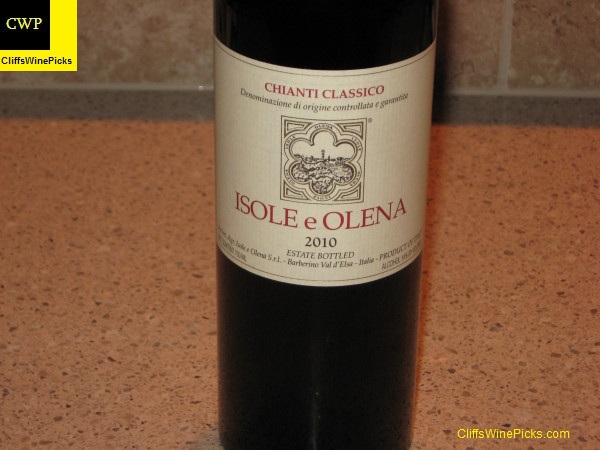
2010 Isole e Olena Chianti Classico – $18.59


My comments

It’s another cold, wet day in the Milwaukee area.  We decided it was a perfect day to defrost some of my wife’s meat sauce and cook up some pasta.  I grabbed a bottle of this from the local store a few weeks ago.  I wanted to try it so I could grab several bottles to last us over Winter if it was acceptable.


Winery history

Many of the wineries in the Chianti Region double as tourist attractions.  Not Paolo De Marchi’s Isole e Olena; when you turn right at the main gate and drive by the burnished steel fermentation tanks, you will come to a muddy square where you may find someone working on a wagon with an arc welder.


“We don’t have time for tourism,” says Paolo.  “It would distract us from our wines.”  His dedication is our gain; Isole e Olena’s wines are superb.  In addition to Chianti Classico, there is Cepparello, a pure Sangiovese of towering complexity and finesse, and a breathtaking Vinsanto.  The winery also produces a Cabernet Sauvignon, a Chardonnay, and L’Eremo, a Syrah.


Syrah is an ancient grape from the RhoneValley, which Paolo originally intended to use to add color and depth to his Chianti Classico (he feels that the Cabernet used in most Tuscan wineries can overwhelm Sangiovese).  However, he has since decided that the best way to improve Chianti is by careful selection of Sangiovese (Chianti’s principal grape), and is working to that end.  Meanwhile, L’Eremo placed fourth in a world-wide blind tasting of Syrah, after three wines from the RhoneValley.


Isole e Olena is also worth visiting if you like to talk wines.  Though Paolo has dropped out of the Consorzio del Marchio Storico (formerly Gallo Nero) for philosophical reasons, he firmly believes in the Chianti Classico region, and his opinions are the result of much thought.  For example, there is a movement to establish extra-high quality subzones within the Chianti Classico region.  “Since one of these zones includes Isole e Olena, it would be good for me,” he says with a grin.  “But so long as wineries can double their quality by hiring new enologists, I’m against it — it’s too soon.”


My Tasting Note

The wine is a nice, ruby red color.  The very nice and pleasing nose has plums, black cherries, baking spices, underbrush, dried herbs, and fresh flowers.  This is barely medium body with ripe tannins and very good acidity.  The wine is rich and lush on the palate with plenty of acidity holding everything together very nicely.  The finish has very nice length with red fruit, spice, and nice earthiness.  A very nice Chianti Classico, I need to pick up some more.  (91 pts)


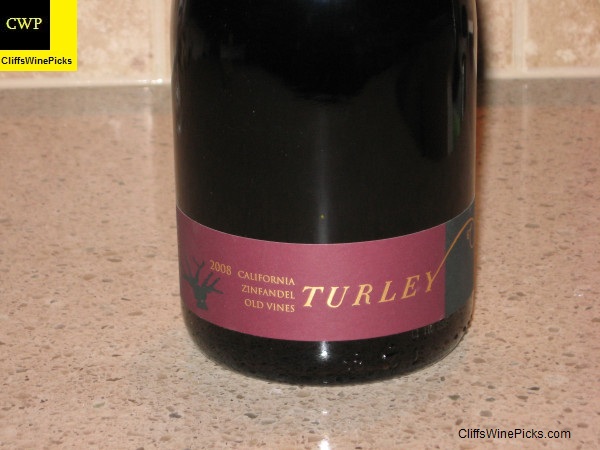
2008 Turley Zinfandel Old Vines – $25.00


My comments

I’ve always been a big fan of both the Juvenile and Old Vines Zinfandels from Turley.  Even though most people feel these are good to go upon release, I thing the Juvenile needs a year in the cellar and the Old Vines needs two years to lose some of the “baby fat” and to show their best.  These are two of the better priced zins on the market at $20 for the Juvenile and $25 for the Old Vines.


The Old Vines Zinfandel is made for “left over” juice from the single vineyard wines and from vineyards too small to warrant a single vineyard offering.


Winery history

In 1993, Turley Wine Cellars was founded by Larry Turley, brother of the well-known consulting winemaker Helen Turley.  Turley, had entered the wine business in 1981 as co-founder of the multi-varietal Frog’s Leap Winery, but soon realized that his interest lay in wines made from the Zinfandel grape.


Starting out with just one location in St. Helena, Turley Wine Cellars soon expanded to Templeton with the purchase of the historic Pesenti winery, where Zinfandel had been planted since 1923.


As of 2000, Turley Wine Cellars has had a two-year waiting list for new wine club customers.


In 2007, Turley Wine Cellars was producing approximately 14,000 cases a year of both single-vineyard and regional Zinfandel wines.


By 2011, Turley Wine Cellars is annually producing approximately 16,000 cases of award winning Zinfandel and Petite Sirah wines using multiple “small” vineyards located in Napa and Sonoma counties, and other Paso Robles locations.


My Tasting Note

The wine is a medium to dark ruby color.  The very nice nose has brambly berries, black pepper, vanilla, black cherry, minerals, smoked meat, and some dried herbs.  This is medium to full bodied with fairly solid, ripe tannins and very nice acidity.  The wine is a bit brighter on the palate with cherries and black raspberries, roasted herbs, and black pepper.  The wine has decent length on the finish.  This is a very nice zinfandel that is tasty but could use a bit more complexity.  Not as big and lush as some Turleys but still very enjoyable.  (90 pts)


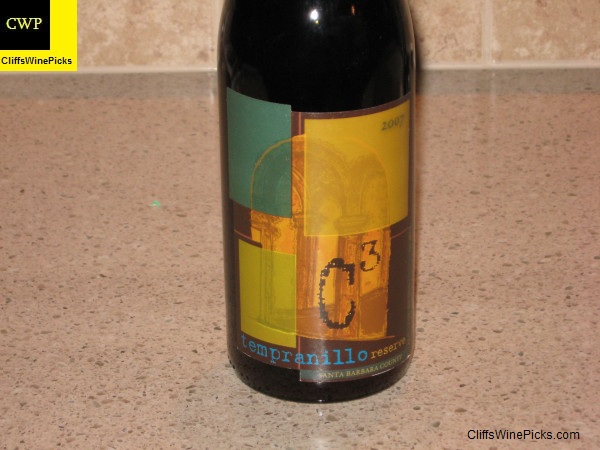
2007 Core Tempranillo C3 Reserve – $17.06


My comments

Since it is International Tempranillo Day, I guess I better open a Tempranillo.  This is a new one for me.  This was part of a set of Core wines that was offered on WineWoot a few weeks ago.  To me, Tempranillo is a grape the California wineries have been struggling with.  I’ve had a few Tempranillo based blends from Villa Creek that have been nice, but most have been disappointing.   Some have been too ripe and jammy, others have seemed under ripe and very tart, too tart.  It’s time to see if Dave Corey is having better success with this Spanish powerhouse grape.


Winery history

Dave Corey’s educational background includes a bachelor’s degree in Biology from San JoseStateUniversity and a master’s degree in Entomology and Plant Physiology from KansasStateUniversity, which was completed in 1995.


Prior to entering the wine industry in 1996, Dave worked in Salinas and the Central Valley in agricultural fields including cole crops, cotton, almonds, citrus, walnuts, kiwi, table grapes, apples and stone fruit.  His first position in the wine industry was as a Pest Control Advisor with Cambria Winery and Vineyards and later at Kendall-Jackson Vineyards of Santa Barbara County.


Dave left Kendall Jackson Vineyards in 1999 to begin Vital Vines, a viticultural company providing technical support for vineyard property owners, vineyard managers and winemaking personnel in the promotion of sustainable agriculture.  He has worked with clients that include Laetitia, Barnwood, Beckman, Melville, Stolpman, Gainey, Zaca Mesa, Sea Smoke, Le Bon Climat, Sine Qua Non, Rideau, Carhartt, Rusack, Westerly, Fiddlestix, Vogelzang, Andrew Murray, Evergreen, Arita Hills and Royal Oaks.


With a major commitment and a second mortgage, Dave gradually decreased his vineyard consulting work to focus on vineyard sourcing, winemaking duties and winery direct sales for CORE wine company which he started in 2001 with his wife, Becky.  Dave passionately continues working in the same capacity today in addition to several new wine projects with family members.  He can also be found pouring wine for customers at the CORE wine company tasting room in Old Orcutt, California.


My Tasting Note

The wine is a slightly hazy deep ruby color.  The wine has an exotic and exciting nose full of cherries, black raspberries, well worn leather, earthy underbrush, baking spices, licorice, and dried herbs.  This has a medium body with fairly solid, ripe tannins and very nice acidity.  On the palate the wine is loaded with tart cherries, raspberries, and baking spices up front with some earthiness and dried herbs in the background adding nice depth and complexity.   The finish is fairly long and full of juicy fruit and spice that slowly gives way to dried herbs and a touch of earthiness.  This is still very young and with the abundance of fruit, acidity, and tannins. some additional cellar time will be rewarded.  One of the better California Tempranillo wines I’ve had the pleasure to enjoy.  (93 pts)


Mailing Lists

I received the Winter offer from Villa Creek for a couple of their wines.  I do not receive an automatic shipment on these wines.  I am still deciding if I want to place an order.


Wines bought or received this week

Carlisle and Myriad are due in this week.


Remember to support your local wine store!


* * * * * * * * * * * * *


Notes – I use the “official” Cellar Tracker name for the wines.  I use Cellar Tracker to help manage and organize my cellar.  I highly recommend checking it out at www.cellartracker.com.  Loading you existing cellar is a lot less intimidating than it would first appear.  There is a good chance 99% of your wine is already in the system, so you generally only need to enter part of the wine’s name and the system will find it for you.


Prices noted are the prices I paid at the time of purchase.  I don’t shop around to find the best prices, but my local store is usually VERY competitive.  I generally get case discounts, and since I work there part time, I get a 5% discount.  Wines purchased direct from a winery do not include any shipping charges.  None of the prices include the sales tax.


All wines that were sent to me free of charge to sample will be noted and I will show suggested prices when available.


Cheers!


Dinner Party October 27, 2012


We had some of our best friends over for dinner on Saturday, October 27th.  Since they are into good wine as much as we are and it’s been quite a while since we’ve “broken bread” together, I decided to pull out a few special bottles.


They were calling for a cold day, so we decided to go with a good, nothing fancy, comfort food, style of dinner, with the wine playing the starring role.


I tried to pick wines that were all different but that would fit into the more laid back, easy living dinner we had planned.


For me, the hardest part of a dinner party is selecting the wines.  I select every one for a specific reason, even if the reason is that I just want to drink one.


On a sad note, after a lot of good food and wine, we ended up not opening the 2007 Saxum James Berry Vineyard.  My review of the Saxum is in my blog from Oct 26-28.


2010 Bedrock Wine Co. Cuvée Karatas – $28.00


My comments

I joined the Bedrock mailing list to get my hands on their red wines, but I am increasing impressed by their white.  I think the Bedrock white wines are some of the best being produced in California.  Across the board they have been outstanding.


My Tasting Note

The wine is a pale, golden yellow color.  The fresh and vibrant nose has melon, white peach, apples, slate, beeswax, flint jasmine, citrus zest, grapefruit, and some white pepper.  This is light to medium bodied with tart, citrusy acidity.  On the palate there is a load of spicy, mineral laden fruit with lemon zest and a healthy splash of grapefruit.  The wine has a long, lingering finish with nice tart grapefruit, lemon zest, and a touch of white pepper.  This is stunning today but will last in the cellar for at least a few years.  (93 pts)


2010 Loring Wine Company Pinot Noir “The Three” – $33.00


My comments

This was a special, limited production, bottling of the best of the best from Loring.  I was able to get a three pack of this wine.  It’s not for a Red Burgundy enthusiast, but a more over the top California version of Pinot Noir.


My Tasting Note

This is a deep, dark ruby color.  The very inviting nose is full of rich and smoky black cherries, earthy blackberries, minerals, baking spices, white pepper, underbrush, and vanilla.  This has medium to full body with fairly solid, ripe tannins and good acidity.  On the palate the wine is full of rich, spicy fruit with some subtle earthiness in the background.  The finish is fairly long with nice, ripe fruit and lingering spiciness.  This is nothing like a Red Burgundy, but that is not the winery’s goal so it succeeds, in my opinion.  (92 pts)


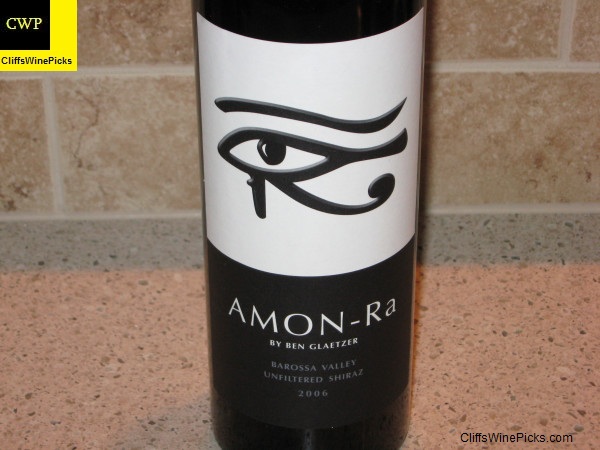
2006 Glaetzer Shiraz Amon-Ra Barossa Valley – $68.74


My comments

Year after year, this is one of the bench mark wines from Australia.


My Tasting Note

The wine is a deep, dark purple color, almost black.  The deep and alluring nose has blackberry, minerals, eucalyptus, baking spices, black cherries, earth, vanilla, licorice, and a nice floral note.  This is medium to full body with solid, ripe tannins and very good acidity.  A bit brighter on the palate than the nose lead me to expect, very ripe but not syrupy or off dry and the acidity and tannins hold everything together.  Very rich and velvety on the palate with layers of flavors that get revealed layer by layer.  The finish is extremely long with the fruit and savory notes seeming to constantly change highlighting a different sensation every couple of seconds.  On of the best wines I’ve ever had, absolutely stunning.  (96 pts)


2008 Myriad Cellars Cabernet Sauvignon Rutherford – $48.00


My comments

Mike Smith is one of the up and coming wine makers in California.  I’m glad I was able to get in on the ground flood of the operation.  The winery also produces a very good Syrah to go with their numerous cabernets.


My Tasting Note

The wine is a deep, dark ruby color.  On the outstanding nose the wine shows cassis, black cherry, Rutherford dust, minerals, licorice, baking spices, dried herbs, and dark chocolate.  This is fairly full bodied with solid tannins and very good acidity.  The wine has a long, lingering finish with spicy fruit and the dried herbs leading the way.  This is extremely young and will improve with a few more years in the cellar.  (93 pts)


Remember to support your local wine store!


* * * * * * * * * * * * *


Notes – I use the “official” Cellar Tracker name for the wines.  I use Cellar Tracker to help manage and organize my cellar.  I highly recommend checking it out at www.cellartracker.com.  Loading you existing cellar is a lot less intimidating than it would first appear.  There is a good chance 99% of your wine is already in the system, so you generally only need to enter part of the wine’s name and the system will find it for you.


Prices noted are the prices I paid at the time of purchase.  I don’t shop around to find the best prices, but my local store is usually VERY competitive.  I generally get case discounts, and since I work there part time, I get a 5% discount.  Wines purchased direct from a winery do not include any shipping charges.  None of the prices include the sales tax.


All wines that were sent to me free of charge to sample will be noted and I will show suggested prices when available.


Cheers!


Oct 22, 2012 to Oct 25, 2012


2007 Alma Rosa Pinot Noir La Encantada Vineyard – $14.99


My comments

I grabbed a few bottles of this wine at a blow out price of $15, based on the wine’s reputation.  We opened a bottle in January 2011, but it was WAY too oaky for our tastes.  I decided to leave it in the cellar for another year or two to see if the oak would integrate, at least a little.


Winery history

Richard Sanford came to the Santa Ynez Valley 40 years ago with the desire to create wines that would rival the best of France.  First to recognize the potential of the Santa Rita Hills (now an officially accredited American Viticultural Area as Sta. Rita Hills), and first to plant Pinot Noir vines there, Richard is a pioneer with a well established reputation for excellence in winemaking.


Working in partnership for more than 30 years, Thekla and Richard Sanford founded multiple, successful winegrowing enterprises.  Their latest venture, Alma Rosa Winery & Vineyards, represents the culmination of a lifetime’s experience – an enterprise dedicated to creating high quality wines and setting a benchmark for organic farming, sustainable agriculture methods, and environment-friendly commerce.


The winery, owned by Richard Sanford, dubbed the father of Santa Barbara Pinot Noir and the first to plant the vine there, filed for Chapter 11 bankruptcy on July 27.


After nearly a half-century of ups and downs in the wine business, Sanford admitted that he’d rather be riding off into the sunset than trying to save the family farm.  “It is true that I have been doing this for 44 years, and Thekla and I were looking forward to having some quiet time,” said Sanford.  “But that’s just not possible yet.”


My Tasting Note

The wine is a deep, dark ruby color.  The big and bold nose has cherries, black raspberries, baking spices, cedar, wild flowers, smoke, and some earthy underbrush.  This has medium to full body, fairly solid tannins, and tart acidity.  Tart cherries hit the palate first, followed by some spices and earthiness before the oak takes over, which it does in a big way.  The finish is fairly long but just about totally oak driven.  If you like oak dominated wine, you’ll like this a lot more than I do.  (86 pts)


2009 Trentadue Winery La Storia “Cuvée 32” – $17.04


My comments

We have visited the AlexanderValley based Trentadue Winery a few times in the past and always had a good time and an even better tasting.  This is a long time favorite wine in my house.  The blend varies each vintage, this one is 49% Sangiovese, 27% Merlot, 8% Montepulciano, 8% Malbec, 7% Petite Sirah, and 1% Syrah.  This wine has enough acidity from the Sangiovese to stand up to dishes with tomatoes but the other grapes lend enough body and oomph to stand up to meat.  We like this wine with everything from pasta with meat sauce to Veal Parmesan and baked ziti.


Winery history

The Trentadue family arrived in SonomaCounty long before their region gained a reputation as the Wine Country. Life-long, hands-on agriculturists, Evelyn and Leo Trentadue contributed significantly to the advancement of their region over the years. In 1959, the Trentadues decided to flee the developers encroaching on their apricot and cherry orchards in Sunnyvale, the area known today around the world as Silicon Valley. To preserve their way of life, these hard-working Italian ranchers purchased 208 acres of land in SonomaCounty’s then remote AlexanderValley.


See more at:  http://www.trentadue.com/winery/heritage.asp


My Tasting Note

The wine is a medium to deep garnet color, much lighter at the edge.  On very enticing nose there are cherries, raspberries, earthy underbrush, dried herbs, baking spices, licorice, blackberries, black pepper, and violets.  The wine has medium body with fairly solid, ripe tannins and very nice acidity.  On the palate the wine is full of tart, spicy, fruit with nice earthy elements and some pepper adding depth and complexity.  The finish is fairly long and features tart, juicy cherries, licorice, and some earthiness.  This is a very nice “Super Tuscan” from California.  Tastes fantastic today, but this will last in the cellar for up to five years.  (91 pts)


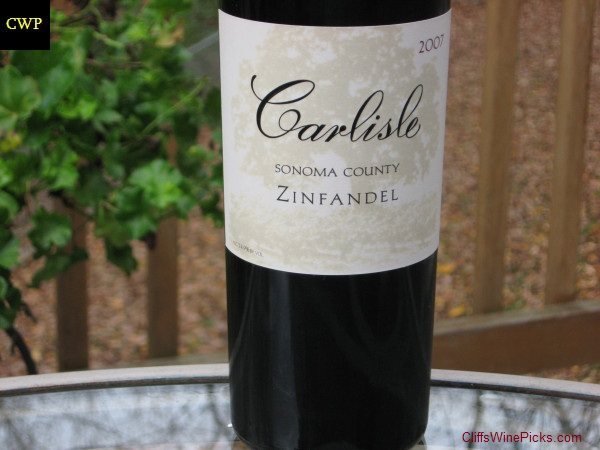
2007 Carlisle Zinfandel Sonoma County – $17.50


My comments

This is one of my all time favorite QPR values.  This is a Zinfandel that is every bit as good as ones that are on shelves at $30 or more, and it cost me well under $20.


Winery history

Carlisle is a winery that started as a classic “garage winery” for Owner/Winemaker Mike Officer.  His first foray into wine making was making 5 gallons of Zinfandel in his kitchen.  Over the next several years, with the help of his wife Kendall (Carlisle), and some friends, he produced a barrel of wine each vintage.  During this period, he also has a “real job” as a software developer.  To make a long story short, eventually the software developer title was left in the rear view mirror and Owner/Winemaker became his new title.  I highly recommend checking out the complete story at http://www.carlislewinery.com/about.html


My Tasting Note

The wine is a deep maroon color.  On the big but civilized nose there are brambly berries, black pepper, dark chocolate, vanilla, licorice, dried herbs, smoke, wild flowers, and a touch of earthiness.  This is medium to full bodied with solid, ripe tannins and very nice acidity.  On the palate the wine shows a load of peppery berries with licorice, dried herbs and a bit of earthiness adding depth and complexity.  The finish is long and features the peppery berries.  An incredible wine and an absolute steal for under $20.  (92 pts)


2007 Novy Family Wines Grenache Judge Family Vineyard – $19.00


My comments

I really like wines from California made with grapes native to France’s RhoneValley.  The thing I most like is what frustrates a lot of people, the variety.  There are soft and fruity wines, full bodied and bold wines, and medium bodied versions full of black pepper and spice.  I like the wines made by Novy because they are usually in the third category, medium bodied and full of spice.  This style is the closest to the styles made in France and also the most food friendly.


Winery history

We met Dianna Lee at an in store wine tasting here in the Milwaukee area a couple years ago.  While we talked she mentioned going to college in East Texas.  After talking a bit more, it turned out she was in college about a mile from our house while we were living in Nacogdoches, TX.  We were able to talk about having Margaritas in a local Mexican Restaurant.  There’s a good chance we were all enjoying happy hour together, a few tables apart.  Who knows, maybe La Hacienda closed down because they lost all our business when we moved to Milwaukee and Dianna met Adam and moved to wine country.  Truly a small world.


For us, the beauty of making our own wine is the total freedom to do it our way, without compromise. Although it is necessary to be able to adapt to new circumstances with each and every vintage, we have found that these principles hold true year after year.


We believe that great wine is made in the vineyard. Only with great grapes can we produce great wines. To this end, we purchase the majority of our fruit by the acre rather than by the ton.

We believe in minimal intervention winemaking that promotes, rather than overshadows the work we do in the vineyard.

Most importantly, we believe that wine should be a pleasure to drink. If you don’t like the way a wine tastes, what’s the point? Novy Family wines are made to be enjoyed with good friends and good food.


My Tasting Note

The wine is a light to medium ruby color, much lighter at the edge.  The very interesting and unique nose has raspberries, earthy underbrush, black pepper, dried herbs, baking spices, smoke, licorice, cherries, and a touch of eucalyptus.  This has medium body with fairly solid, ripe tannins and very nice acidity.  On the palate a nice hit of cherry and raspberry precedes a blast of savory elements including black pepper, dried herbs, and nice earthy notes.   The finish is fairly long and leans towards the savory spectrum with nice cherry and raspberry in the background adding subtle sweetness.  Not a fruit forward, fruit bomb, very food friendly.  I like this a lot and feel it should last in the cellar for another year, maybe two.  (92 pts)


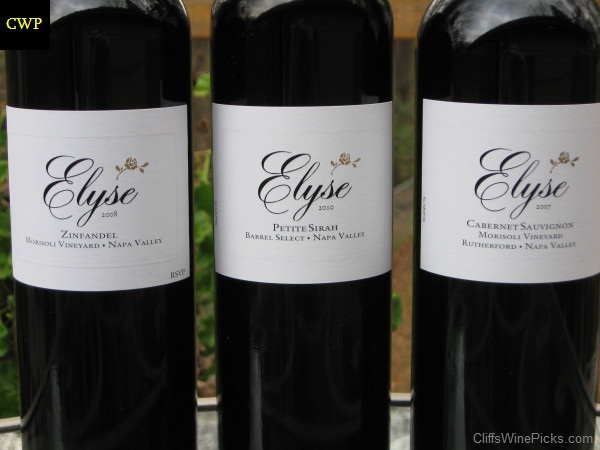
Nice delivery of samples from Elyse for me to review arrived today.  I look forward to sampling them in the next couple of weeks.  The reviews will be in a special edition of Cliff’s Wine Picks.  Selections include 2008 Morisoli Zinfandel, 2010 Barrel SelectNapa Valley Petite Sirah, and the 2007 Morisoli Cabernet Sauvignon.


Mailing Lists

The Loring e-mail with their non Pinot Noir wine hit and I immediately grabbed several bottles.  My main buys were the Grenache and the Convergence wines.


Wines bought or received this week

I received the samples noted above from Elyse, but that is all, so far.  If everything gets delivered tomorrow that is due, I’ll receive wine from Core (WineWoot), Garagiste Wine, and from a new favorite, Ledge.


Remember to support your local wine store!


* * * * * * * * * * * * *


Notes – I use the “official” Cellar Tracker name for the wines.  I use Cellar Tracker to help manage and organize my cellar.  I highly recommend checking it out at www.cellartracker.com.  Loading you existing cellar is a lot less intimidating than it would first appear.  There is a good chance 99% of your wine is already in the system, so you generally only need to enter part of the wine’s name and the system will find it for you.


Prices noted are the prices I paid at the time of purchase.  I don’t shop around to find the best prices, but my local store is usually VERY competitive.  I generally get case discounts, and since I work there part time, I get a 5% discount.  Wines purchased direct from a winery do not include any shipping charges.  None of the prices include the sales tax.


All wines that were sent to me free of charge to sample will be noted and I will show suggested prices when available.


If you want me to review your wines, see my Sample Policy or e-mail me at Cliff@CliffsWinePicks.com


Cheers!

Oct 19, 2012 to Oct 21, 2012


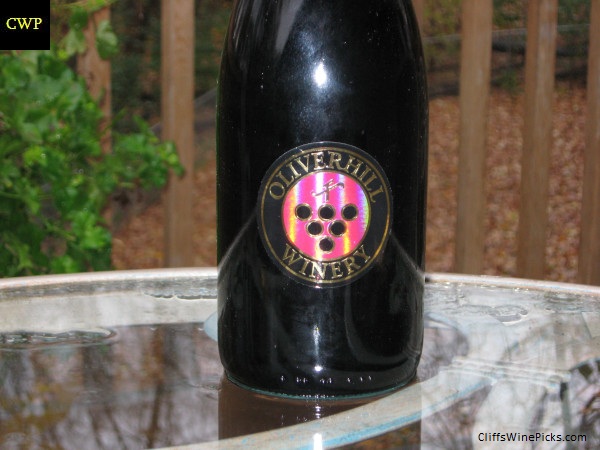
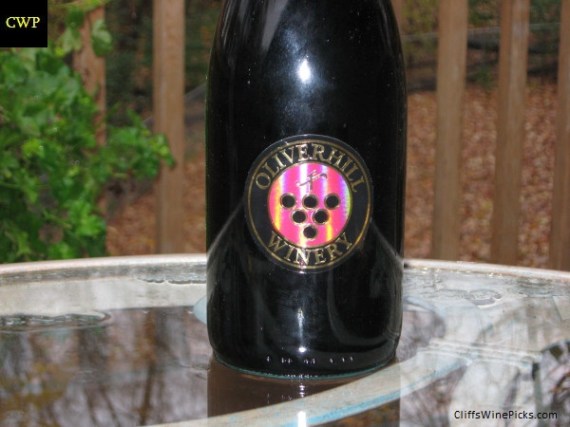
2006 Oliverhill Winery Shiraz Jimmy Section – $19.00


My comments

One of my wife’s all time favorite wines.  How much does she like it?  Per Cellar Tracker I bought a total of 33 bottles, and his will be the 24th bottle we’ve opened since December 2009.


I should add I like this wine as well.  I still do not understand how it was such a slow mover at the local wine store.  This is part of my last case which only cost me $19.00, a bottle.  A steal based on the $35 release price.


Winery history

Stuart Miller is the winemaker and caretaker of the vineyard: this is truly a hands-on winery where every step of production from vineyard to bottling is overseen by Stuart himself.  His family are involved in all stages of the process, picking grapes, pruning vines, bottling, packaging and more.


Oliverhill was established in the early 1970s and the Miller family moved in during the early 1990s.


My Tasting Note

The wine is a deep, inky purple color.  The very inviting nose is full of blackberries, black pepper, vanilla, smoldering charcoal, licorice, leather, wild flowers, and dark chocolate.  This is fairly full bodied with solid, ripe tannins and very nice acidity.  On the palate the wine gives a big blast of ripe, juicy berries with spicy oak and black pepper adding nice savory elements.  This is a big, bold, and ripe wine that pushes the ripeness but does not cross over into the sweet or syrupy level.  (93 pts)


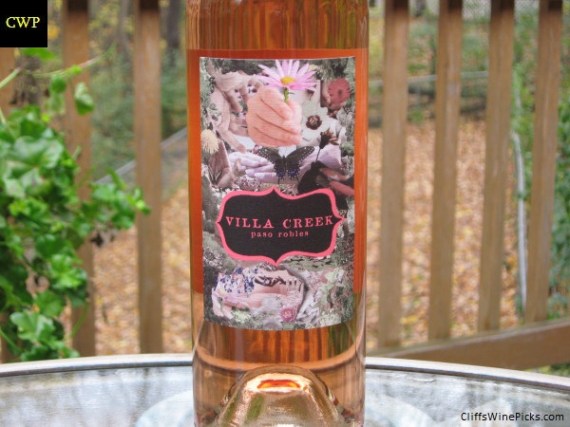
2011 Villa Creek Pink – $12.80


My comments

Having a little Rosé tasting with a friend today, so my contributions are this wine and the Bedrock listed below.  These two along with the One Time Spaceman MCA Rosé were the work horse wines this Summer in my house.


Winery history

In the spirit of the great wine producers of the southern Rhone and the bodegas of Rioja and Priorat, blending is what Villa Creek does best. The area’s finest Grenache, Syrah, Mourvedre and Tempranillo Vineyards are just a stone’s throw from the west Paso Robles winery where these blends are lovingly produced by winemaker Cris Cherry and his wife JoAnn.


The grapes of the area’s most progressive vineyards, James Berry, Denner, Ohana and Booker, currently grace the wines of Villa Creek Cellars. Per acre contracts insure that the fruit comes off the same blocks each vintage. The Cherry’s own 70 acre estate on the west side of Paso Robles boasts elevations of 1400-1800 feet, calcareous soils, south facing slopes and ample water. In the spring of 2012, the Cherry’s finished planting their first grape vines, 3.5 acres of Grenache. They look forward to planting Mourvèdre and Carignan in the months to come.


My Tasting Note

The wine is a very nice looking pinkish salmon color.  The very crisp and clean nose has strawberries, white peaches, cherries, Asian spices, citrus zest, and a touch of earthiness.  Light to medium body with crisp acidity and just a touch of sweetness makes for a very nice, easy drinking wine on a warm evening.  The palate has nice crisp, sweet fruit and spices with some earthiness lurking in the background.  The finish shows nice length with the fruit and spice slowly giving way to a touch of mouthwatering, citrusy acidity.  A very nice Rose with or without food.  (91 pts)


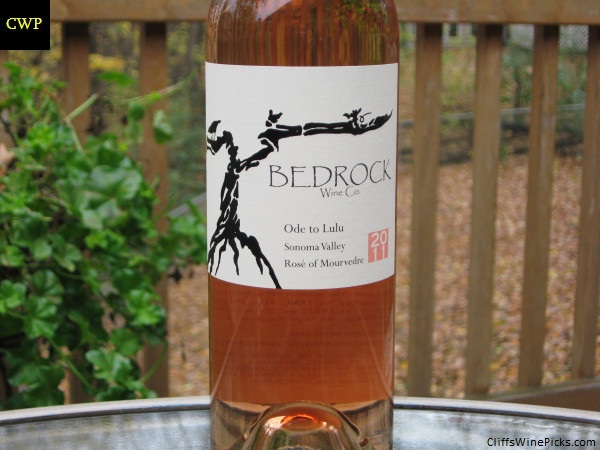
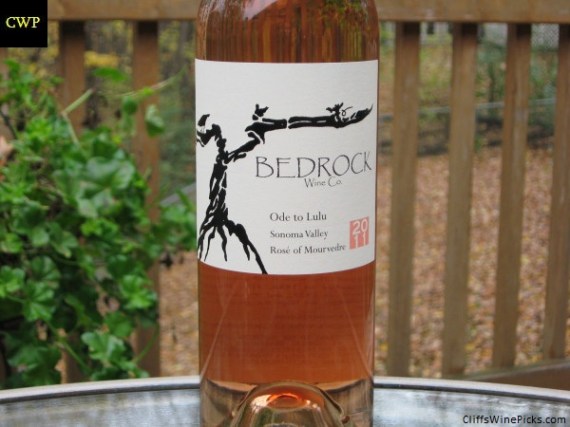
2011 Bedrock Wine Co. Mourvedre Ode to Lulu Rosé – $18.00


My comments

Having a little Rosé tasting with a friend today, so my contributions are this wine and the Villa Creek listed above.  These two along with the One Time Spaceman MCA Rosé were the work horse wines this Summer in my house.


Winery history

Bedrock is an itsy-bitsy winery making wine in a converted chicken coop. Fruit from only the most excellent vineyard sites is hand pitch-forked into the destemmer, fermented in open top redwood and stainless vats using only native yeasts, and are manually basket pressed by winemaker Morgan Twain-Peterson into the sexiest oak from the coldest French forests.


The winery’s objectives are:

.  To channel the fruit of ancient vines into powerful, elegant, and distinctly Californian wines.

.  To spread the gospel of Syrah in California by sourcing fruit from great terroirs throughout the NorthCoast.

.  To proclaim the greatness of Sonoma Valley Cabernet Sauvignon by sparing no expense on wines of uniqueness and personality.

.  To reclaim rose’ from the excesses of saignee and focus on precision, delicacy, aromatics, and food friendliness.

.  To make fascinating and quixotic white wines from unique sites and interesting varietals.

.  To make California Pinot Noir that ages as well as ’74 Swan.

.  To dream big but keep production low!


My Tasting Note

A nice, light, pinkish salmon color. Minerals, strawberry, white pepper, melons, orange zest, and a bit of dusty earthiness on the very appealing nose.  Light body with crisp acidity.  A very dry rose with nice minerality and fruit with the white pepper and citrus making an appearance on the back end.  Nice, lingering, mouthwatering finish.  The real deal.  Even those who like a crisp French Rose will find pleasure in this wine.  (92 pts)


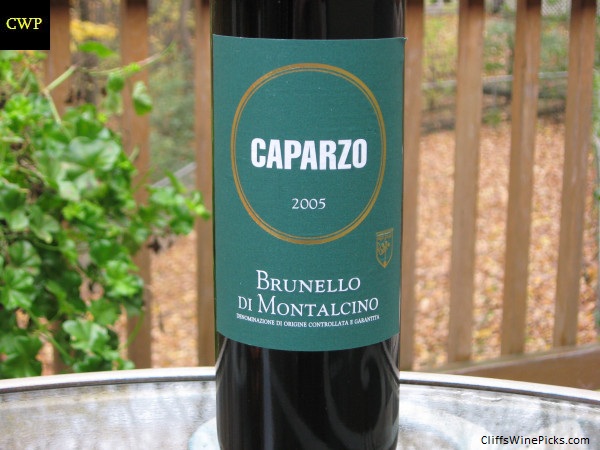
2005 Tenuta Caparzo Brunello di Montalcino – $26.91


My comments

I’ve been wanting to check in on this wine again.  We had a bottle about a year and a half ago and though it was enjoyable, I felt it needed some additional cellar time.


Winery history

The “Caparzo” name seems to originate from Ca’ Pazzo, as seen in several ancient maps.

The vineyards, cellars and all wine-making equipment were developed towards the end of the 1960s, with progressive adaptation and constant up-dating of both the land and the cellars.

Innovative cultivation systems and, in particular, several clones are still experimented today on the estates – extending over an area of 200 hectares (470 acres), comprising 90 hectares of vineyards, 4 of olive groves, 87 of woodlands and 19 of sowable land.


Caparzo aims to ensure top quality products through meticulous, craftsmanlike techniques while equally taking a modern approach to management, efficiency and business relationships.

More than forty years have passed from the first rows of vines and from the first wine-shop experiences.

Caparzo has since grown while keeping faith with the traditions of Brunello and the various local terroirs, at the same time as enhancing its wines with creative spirit and dedication to innovation as a means of ensuring the highest possible quality.

This is why Caparzo wines are served by the most famous restaurants in the world, as well as at international meetings and on official State occasions.


My Tasting Note

This was decanted for about two hours.  The wine is a ruby to garnet color, much lighter at the edge.  On the very nice nose there is cherry, raspberry, well worn leather, cedar, sautéed mushrooms, baking spices, dried herbs, wild flowers, and earthy underbrush.  This is medium body with moderate, ripe tannins and good acidity.  The wine has a nice initial attack on the palate but the oak eventually takes over.  The finish had nice length but the oak once again dominates.  A bit of excess oak can be over looked, but this is a couple steps beyond just excess.  Hopefully I’m just catching it at a bad time and the other elements will show up, but for now, let this one sleep unless an abundance of oak is not a problem for you.  Checking an earlier tasting note, I didn’t list excess oak as being a problem.  I’m leaning towards catching the wine at a bad point in its evolution.  If that is the case, my score will be dreadfully low.  (86 pts)


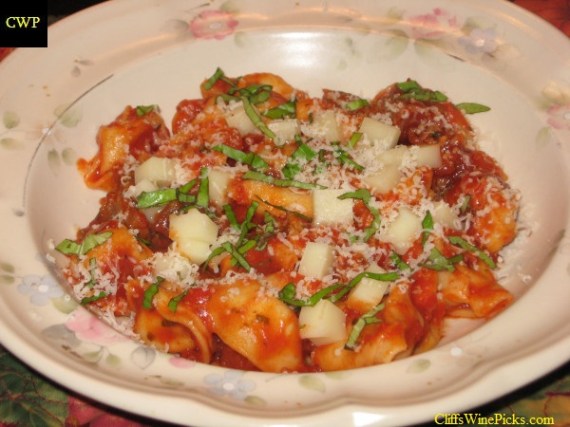
We had the Brunello with some Tortellini in Marinara Sauce with Italian Sausage, Mozzarella, and fresh Basil.  A fantastic pairing!


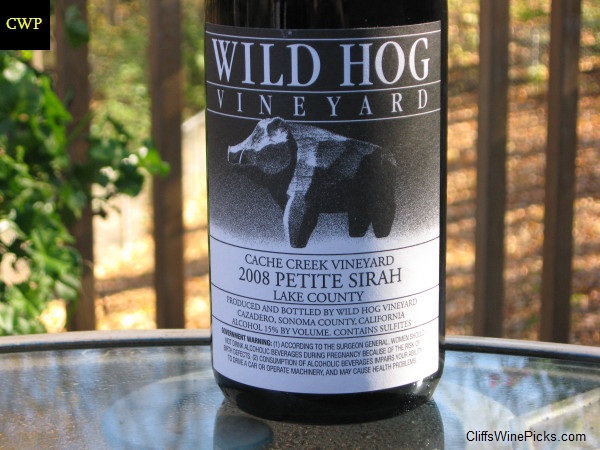
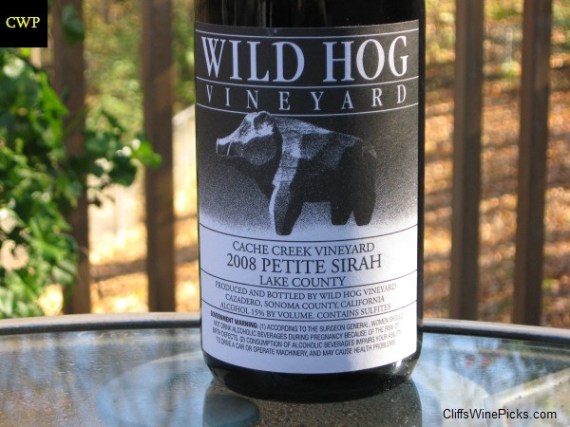
2008 Wild Hog Vineyard Petite Sirah Cache Creek – $9.97


My comments

The 2007 vintage of this wine was a show stopper for under $10.  When the local received a small cache of the 2008 vintage and made it available for $10 via an e-mail offer, I had to grab a case.  My first bottle wasn’t up to the level of the 2007, but it showed considerable promise.  I don’t know the story behind this vintage since the winery’s website says the 2007 was the last one produced.


Winery history

At Wild Hog Vineyard it is difficult to separate the wine from the winemaker. Daniel Schoenfeld began making wine as a home winemaker in 1977. He loved good food and wine and wanted to share his enjoyment with friends. He and Marion, his wife and co-owner, are both gardeners with a passionate belief in sustainable living. Marion tends a three acre organic garden which produces the vegetables and fruits that the family consumes. Daniel farms the five acre vineyard above the house. Together with their two children, Iris and Ariel, they harvest the bounty from the land. They take from the land only what they give in return.


As a winemaker, Daniel has a very simple view-allow the fruit to speak for itself. All Wild Hog wines are unfiltered allowing the full flavor to be extracted. The grapes are picked ripe and crushed (or de-stemmed) into open top fermentors-1 to 4 ton size. Yeast is added and the must will ferment 10 to 21 days, until dry. The must is then pressed and the juice held in American oak barrels. After 12 months in the barrel for Pinot Noir and 18 months for Zinfandel, the wine is bottled at the winery, using our own equipment. Since we do no filtering, the wine is racked two or three times during its time in the barrel. The winery produces between 3000 to 4000 cases per year, depending on harvest and availability of good fruit.


My Tasting Note

The wine is a deep ruby color.  The intriguing nose has blackberries, black pepper, minerals, eucalyptus, licorice, violets, dried herbs, and some earthy underbrush.  This is barely medium body with fairly solid tannins and very nice acidity.  On the palate the wine shows peppery, crushed berries, some earthiness and minerality, and the eucalyptus note on the back end.  The finish has very nice fruit and savory elements, and has decent length.  I really like the mint/eucalyptus note that carries through from the nose to the finish.  The label says 15% alcohol, but it seems much lower.  This is not a big, ripe, fruit forward wine like the 2007.  (90 pts)


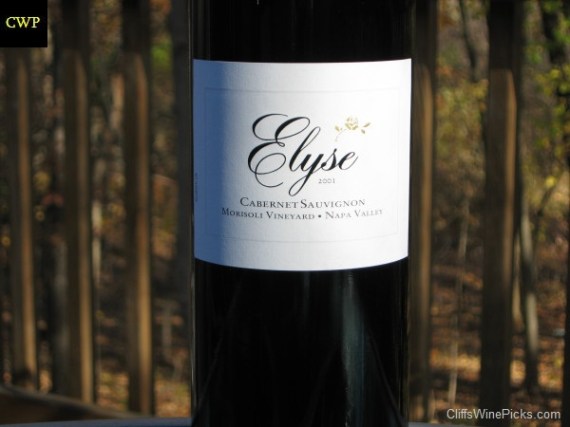
2001 Elyse Cabernet Sauvignon Morisoli Vineyard – $30.00


My comments

The Elyse Morisoli Vineyard Cabernets have been a personal favorite for several years.  The Mosisoli Cabernet, like a lot of the great Napa Valley Cabs taste very nice upon release, but some time in the cellar helps bring out the nuances and terrior, transforming them into something special.


Winery history

NapaValley’s Elyse Winery has two causes for celebration this harvest. In addition to a stellar looking 2012 vintage in NapaValley, it is the 25th harvest for the winery.


It was back in 1987 that Ray and Nancy Coursen crushed 4.5 tons of Zinfandel from the Morisoli Vineyard in Rutherford to craft 286 cases of their first wine. While the portfolio has grown over the last 25 years, the focus remains on creating vineyard driven wines that pair well with food. Total production is currently 10,000 cases and the wines are nationally and internationally distributed.


Winemaking is cooking without a flame. Our winemaking philosophy at Elyse in NapaValley is similar to the approach of a great chef who carefully prepares artisan grown ingredients to bring each layer of flavor to the table. Long term alliances with our growers form the cornerstone to our portfolio of vineyard driven wines that possess an unfaltering affinity for pairing with food.


“A meal with wine is dining – it’s a conversation, an event. It’s what wine is all about.” – Ray Coursen, Winemaker & Owner


“This excellent winery continues to carve out a well-deserved reputation for its interesting red wine portfolio.” – Robert M. Parker Jr.


My Tasting Note

The wine is a very nice, deep ruby color, showing absolutely no sign of age.  The outstanding nose has cassis, smoke, well worn leather, fresh ground coffee, dark chocolate, dried herbs, tobacco, and a faint hint of cedar.  This is medium bodied with nice, ripe, integrated tannins and very nice acidity.  The wine is very civilized and refined on the palate with a nice fruit to savory balance.  The finish is long and full of cassis, dried herbs, and dark chocolate.  Very food friendly, but I’m very much enjoying a post dinner glass.  This can easily rest in the cellar for a few more years, but it is stunning today.  (94 pts)


Mailing Lists


Loring Wine Company

This could get costly.  Loring is one of our favorite wineries.  They are mainly into making big and ripe Pinot Noirs, but have branched out a bit.  Now they are going about three steps beyond just branching out.  In their next release on October 24th, they will be releasing five wines, none of which is Pinot Noir based.  This release will include the following:


2011 Grenache

Amazingly pure high notes of blackberry, plum, and red and black cherry. Plush and rich, but the acidity keeps it bright and focused. Concentrated but not heavy. Spice and minerality round out the finish.


2011 Mourvedre

A symphony of blackberry, coffee, dark chocolate, and vanilla. Great intensity and precision, with depth and richness. Once again, great acidity holds everything together in one seamless chorus of deliciousness.


2010 Cabernet Sauvignon

A dizzying array of blackberry, red and black cherry aromas and flavors, along with deep crème de cassis. Nice elements of baking spice and toasty oak. Muscular, dense, and concentrated on the palate, but still bright with a surprisingly elegant finish due to great acidity.


2010 Convergence (75% Grenache / 25% Mourvedre)

Super intense with layers of ripe raspberry, blackberry, baking spice, and vanilla that jump out of the glass. Deep and concentrated on the palate, with additional notes of smoked meat and minerality in the finish. An immense wine that’s still light on its feet.


2010 Divergence

The 2010 is a little less crazy than our past two vintages, but it’s still one of the biggest, baddest wines you’ll ever come across. Massive in every way, but still amazingly balanced. Blackberry, Chocolate, and Vanilla cascade over your palate. Insanely concentrated and mouth-coating, but with stunning acidity that keeps the finish bright and focused.


Visit http://loringwinecompany.com/ for more information or even better, to sign up for the mailing list.


Wines bought or received this week

Direct from the winery:

(6) 2007 Graeser Cabernet Franc Estate Grown DiamondMountain

(4) Villa Creek Mas de Maha

(3) Vila Creek Avenger

(2) Villa Creek High Road James Berry Vineyard


From local wine store:

(6) 2006 Alma Rosa Pinot Blanc SantaRitaHills – Sta.RitaHills

(3) 2007 Tenuta Caparzo Brunello di Montalcino

(2) 2009 Trentadue Winery La Storia “Cuvée 32”

(1) 2009 Pali Wine Co. Pinot Noir Riviera


Remember to support your local wine store!


* * * * * * * * * * * * *


Notes – I use the “official” Cellar Tracker name for the wines.  I use Cellar Tracker to help manage and organize my cellar.  I highly recommend checking it out at www.cellartracker.com.  Loading you existing cellar is a lot less intimidating than it would first appear.  There is a good chance 99% of your wine is already in the system, so you generally only need to enter part of the wine’s name and the system will find it for you.


Prices noted are the prices I paid at the time of purchase.  I don’t shop around to find the best prices, but my local store is usually VERY competitive.  I generally get case discounts, and since I work there part time, I get a 5% discount.  Wines purchased direct from a winery do not include any shipping charges.  None of the prices include the sales tax.


All wines that were sent to me free of charge to sample will be noted and I will show suggested prices when available.


Cheers!
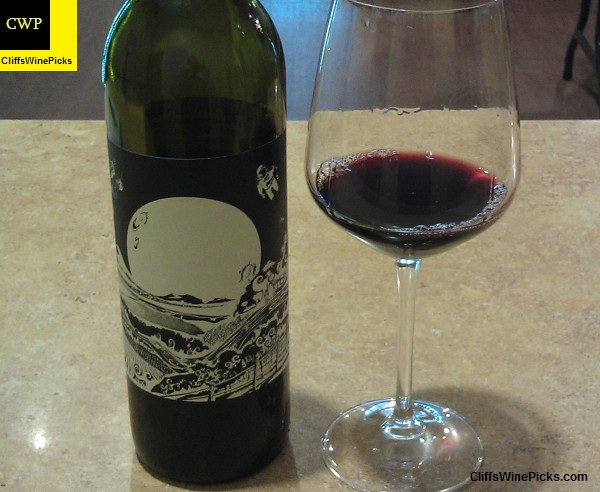
 

Oct 15, 2012 to Oct 18, 2012


2007 Ridge Geyserville – $26.59


My comments

I’d be hard pressed to pick my favorite Zinfandel based blend coming out of California between Ridge’s Geyserville and their Lytton Springs.  These are both wines that taste pretty good upon release, but transform into something magical with some cellar time.  These are generally not the type of zins that grab you by the throat and club you over the head.  These are much more refined and elegant.


Winery history

The history of Ridge Vineyards begins in 1885, when Osea Perrone, a doctor who became a prominent member of San Francisco’s Italian community, bought 180 acres near the top of Monte Bello Ridge. He terraced the slopes and planted vineyards; using native limestone, he constructed the Monte Bello Winery, producing the first vintage under that name in 1892. This unique cellar, built into the mountainside on three levels, is Ridge’s production facility. At 2600′, it is surrounded by the “upper vineyard.”


In the 1940s, William Short, a theologian, bought the abandoned winery and vineyard just below the Perrone property; he replanted several parcels to cabernet sauvignon in the late 1940s. From these vines — now the “middle vineyard”— new owners Dave Bennion and his three partners, all Stanford Research Institute engineers, made a quarter-barrel of “estate” cabernet. That Monte Bello Cabernet was among California’s finest wines of the era. Its quality and distinctive character, and the wines produced from these same vines in 1960 and ’61, convinced the partners to re-bond the winery in time for the 1962 vintage.


The first zinfandel was made in 1964, from a small nineteenth-century vineyard farther down the ridge. This was followed in 1966 by the first Geyserville zinfandel. The founding families reclaimed the Monte Bello terraces, increasing vineyard size from fifteen to forty-five acres. Working on weekends, they made wines of regional character and unprecedented intensity. By 1968, production had increased to just under three thousand cases per year, and in 1969, Paul Draper joined the partnership. A Stanford graduate in philosophy—recently returned from setting up a winery in Chile’s coast range—he was a practical winemaker, not an enologist. His knowledge of fine wines and traditional methods complemented the straightforward “hands off” approach pioneered at Ridge. Under his guidance the old Perrone winery (acquired the previous year) was restored, the finest vineyard lands leased or purchased, the consistent quality and international reputation of the wines established. Cabernet and Zinfandel account for most of the production; Syrah, Grenache, Carignane, and Petite Sirah constitute a small percentage. Known primarily for its red wines, Ridge has also made limited amounts of chardonnay since 1962.


My Tasting Note

This was decanted for about an hour.  The wine is a deep ruby to maroon color.  The wonderful and fully open nose has brambly berries, freshly cracked black peppercorns, licorice, baking spices, black cherries, with hints of underbrush, vanilla, grilled meat, and just a touch of earthiness.  This has medium body with fairly solid, ripe tannins and very nice acidity.  The finish is fairly long with nice fruit giving way fairly quickly to the more savory elements.  There is a touch of excess oak peeking through towards the end, but it should better integrate with a bit more cellar time.  This is an outstanding Geyserville that will drink nicely through the end of the decade.  (92 pts)


2008 JC Cellars The Impostor – $25.73


My comments

This is a blend of  Zinfandel, Syrah, Petite Sirah, Tempranillo, Carignane, Grenache and Viognier.


Winery history

Jeff Cohn, the winemaker, president, and “JC” of JC Cellars got his start in the industry almost 20 years ago. As an intern at Boordy Vineyards in Maryland, he drove an hour and half each way to prune vines in frigid weather, pick grapes in stifling heat, and scrub everything from barrels to floors.


Long before he began his winemaking career he received an associate degree in culinary arts from Johnson & WalesUniversity, and a bachelor’s degree in hospitality management from FloridaInternationalUniversity.


Cohn had always loved the hospitality industry, and as he worked through several high profile positions after college he found his passion for wine steadily growing. The more he learned, the more he wanted to learn, until he realized that becoming a winemaker was his ultimate goal. The job at Boordy was a deciding factor in the trajectory of his career — in spite of all the scrubbing.


With the encouragement and support of his family, Cohn moved to California in 1993 to follow his dream. He earned his master’s degree in agriculture chemistry, with an emphasis on enology, from CaliforniaStateUniversity, Fresno in 1996. It was here that Cohn discovered French winemaking techniques and the concept of terroir. “The flavor profile was so different than anything else I had ever tried,” he says of the first Chateauneuf-du-Pape he tried in school. “It was a shocker. To go from tasting only single varietals to a blend really opened my eyes.”


For more info, visit http://www.jccellars.com/about-jeff-cohn.html


My Tasting Note

The wine is a deep purple color.  The big and bold nose has brambly berries, black pepper, smoked meat, licorice, vanilla, dark chocolate, and violets.  This is fairly full bodied with big, solid tannins and good acidity.  On the palate the juicy, ripe, peppery berries lead the full throttle charge with nice savory elements providing depth and help to balance out the fruit.  The finish has nice length, again with a nice fruit to savory mix.  This is big and ultra ripe, but does not come across as overly alcoholic, sweet, or raisiny.  A very nice and successful balancing act.  (91 pts)


2009 Bedrock Wine Co. Syrah Sonoma Coast – $20.00


My comments

To me, Morgan Twain-Peterson from Bedrock is trying to follow playbook written by Mike Officer at Carlisle.  The playbook is fairly simple, offer outstanding, personality filled wine at good prices.  Though relatively new to the game, Bedrock is following the playbook to perfection.  Bedrock has one upped Carlisle in one regard, besides their outstanding red wines, they put out some of the best white wines being produced at reasonable prices in the state.


Winery history

Bedrock is an itsy-bitsy winery making wine in a converted chicken coop. Fruit from only the most excellent vineyard sites is hand pitch-forked into the destemmer, fermented in open top redwood and stainless vats using only native yeasts, and are manually basket pressed by winemaker Morgan Twain-Peterson into the sexiest oak from the coldest French forests.


The winery’s objectives are:


.  To channel the fruit of ancient vines into powerful, elegant, and distinctly Californian wines.

.  To spread the gospel of Syrah in California by sourcing fruit from great terroirs throughout the NorthCoast.

.  To proclaim the greatness of Sonoma Valley Cabernet Sauvignon by sparing no expense on wines of uniqueness and personality.

.  To reclaim rose’ from the excesses of saignee and focus on precision, delicacy, aromatics, and food friendliness.

.  To make fascinating and quixotic white wines from unique sites and interesting varietals.

.  To make California Pinot Noir that ages as well as ’74 Swan.

.  To dream big but keep production low!


My Tasting Note

This was decanted for about an hour.  The wine is a deep, dark ruby to purple color.  The very open and inviting nose has blackberries, smoke, charcoal, cocoa powder, grilled meat, black pepper, roasted herbs, leather, and some blueberry.  This is medium to full bodied with sold tannins and very nice acidity.  On the palate the wine shows a big fruit and spice component with grilled meat, dried herbs, dark chocolate, and baking spice adding depth and loads of complexity.  The finish is fairly long and leans heavily on the savory elements with the fruit in the background.  This is still young and evolving but very tasty.  (91 pts)


2004 Palmaz Vineyards Cabernet Sauvignon Cedar Knoll Vineyard Co. – $18.21


My comments

This wine’s normal price is in the $45 to $49 range, which I feel is WAY too high.  The community average price in CellarTracker for this wine is over $28, which is again pushing the limit.  Luckily I was able to grab half a case for well under $20.  That makes it a good Napa Valley Cab at a price that won’t break the bank when consumed on a week night, especially for an aged Cabernet is in its’ prime drinking window.


I’ve had a couple bottles that I liked and rated 89-90 points.


Winery history

Cedar Knoll Vineyard and Winery was founded in 1881 by Henry Hagen. One of their wines won a Silver Medal at the Paris Exposition in 1889. At that time, Cedar Knoll was one of Napa’s premier wineries. The winery was a victim of Prohibition and was closed for close to 80 years. Cedar Knoll is now owned by the Palmaz family. They have resurrected the vineyards and restored the original Hagen house. The vineyards occupy 55 acres and are located just northeast of the city of Napa.


My Tasting Note

The wine is a fairly deep ruby color, much lighter at the edge.  On the fairly straight forward nose there is cassis, cedar, dried herbs, tobacco, raspberries, smoke and a touch of cherry and leather.  This is medium body with soft, integrated tannins and good acidity.  Nice sweet fruit on the palate with dried herbs and spicy oak coming through on the backend.  Nice length on the finish which shows more of the savory side with the fruit just providing a touch of sweetness.  Drinking nicely now, but I’d probably lean towards drinking over the next year or two before the fruit fades and leaves the oak component as the dominant element.  (89 pts)


Mailing Lists


It’s shipping season so most mailing lists have already been completed.


Wines bought or received this week

I received a 5 bottle sampler pack from The Seeker Wines.


Set included:

2010 California Chardonnay (unoaked!)

2011 New Zealand Sauvignon Blanc

2011 French Pinot Noir

2010 Argentina Malbec

2011 Chilean Cabernet Sauvignon


These will be sampled in the next couple of weeks.  They will be the subject of their own blog posting.  I’m looking forward to giving these a try.


 Remember to support your local wine store!


* * * * * * * * * * * * *


Notes – I use the “official” Cellar Tracker name for the wines.  I use Cellar Tracker to help manage and organize my cellar.  I highly recommend checking it out at www.cellartracker.com.  Loading you existing cellar is a lot less intimidating than it would first appear.  There is a good chance 99% of your wine is already in the system, so you generally only need to enter part of the wine’s name and the system will find it for you.


Prices noted are the prices I paid at the time of purchase.  I don’t shop around to find the best prices, but my local store is usually VERY competitive.  I generally get case discounts, and since I work there part time, I get a 5% discount.  Wines purchased direct from a winery do not include any shipping charges.  None of the prices include the sales tax.


All wines that were sent to me free of charge to sample will be noted and I will show suggested prices when available.


Cheers!


Oct 12, 2012 to Oct 14, 2012


2009 Anthill Farms Syrah Sonoma Coast – $18.00


My comments

Though mostly noted as a Pinot Noir producer, I have been loving their cool climate Syrahs the last could of vintages.  Though ripe as often happens with California fruit, these normally don’t push the envelope when it comes to ripeness.  These have the nice California fruit flavors, but generally maintain the savory elements that are sometimes lost when the fruit is picked at higher brix levels.
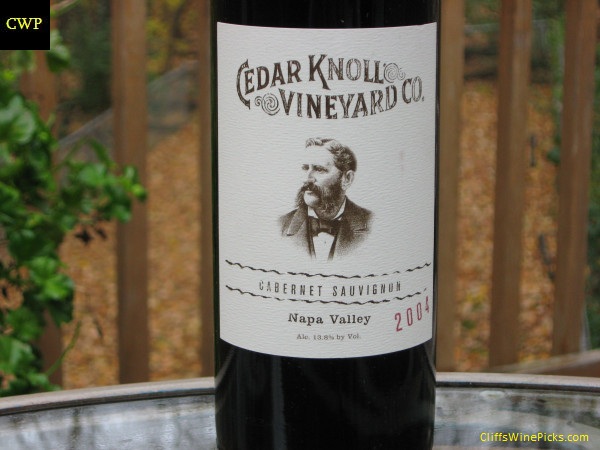
 

Winery history

In 2011 Anthill Farms was named one of the top 100 wineries in the world by Wine & Spirits magazine.


Founded in 2004, this new producer with the quirky name and unique label has burst on the scene with startling good Pinot Noirs made from purchased grapes. This project is one of many that has ties with the Williams Selyem winery. Three young Pinot amigos, who had worked together as cellar hands at the distinguished winery on Westside Road launched their own winery with three Pinot Noir releases in 2004. Anthony Filiberti grew up in SonomaCounty and was lured to wine at an early age. He learned winemaking at Bergstrom Winery in Newberg, Oregon, Hafner Vineyards in the AlexanderValley, and Williams Selyem. David Low grew up in Kansas but got hooked on wine while attending University of California Berkeley. A short stint as a computer programmer was followed by a change of heart and he later worked at both Williams Selyem and Papapietro Perry. Webster Marquez grew up on the East Coast and attended college in Virginia. Here he began working as an assistant winemaker at Jefferson Vineyards. He then moved to SonomaCounty where he joined Williams Selyem. Currently he is the assistant winemaker at Belvedere Winery in Healdsburg. The trio’s goal is to craft Pinot Noirs which “express the growing site and the characteristics of the vintage, and above all else, taste good.” Their emphasis is on the vineyards and have named their winery Anthill Farms to emphasize the many tiny individual vineyards that form “the link between place and product.” Their grape sources are NorthCoast vineyards in Sonoma and Mendocino counties.


My Tasting Note

The wine is a deep maroon color.  The deep and dark nose has smoked meat, blackberries, minerals, fresh cracked black pepper, baking spices, licorice, and dried flowers.  This has a medium body with fairly solid, ripe tannins and very nice acidity.  Like the nose, this is deep and dark on the palate with the blackberries, minerals, pepper, and a meaty element.  The fruit brightens a bit on the lengthy finish, adding some raspberry and even a touch of cherry to go with the meaty notes.  Still on the young side, but already stunning.  (92 pts)


2007 Westerhold Family Vineyards Syrah Westerhold Vineyard – $42.00


My comments

This is a wine I tried due to Russell Bevan being the winemaker.  It absolutely blew me away.  I quickly ordered more and put the word out on Twitter.  I suggested to Jeb Dunnuck that he should track down a bottle to try, he then gave it 95+ on his The Rhone Report.  A wine store owner friend from Napa (yes, you Carrie) bought some for the store based on my recommendation, and had to restock since it became very popular.  I’m not sure the status of the winery’s mailing list, but I’d recommend checking to see if it is still open.


Winery history

Not much history, but I was able to get this from their website:

Westerhold Family Vineyards is located southeast of Santa Rosa in the Bennett Valley AVA of Sonoma County. We are a small winery dedicated to the production of estate grown Syrah, and in 2013 we will release our inaugural estate grown Pinot Noir.


If you would like to be added to our mailing list or would like more information, please send an email to info@westerholdwines.com.


My Tasting Note

The wine is a deep maroon color.  The irresistible nose has blackberries, smoked meat, black pepper, charcoal, dried herbs, melted licorice, baking spices, and a hint of violets.  This is fairly full body with solid, ripe tannins and very good acidity.  This is lush and ripe on the palate but not really pushing the ripeness to the edge.  The palate shows nice peppery berries, licorice, and some smoked meat with baking spices and dried herbs in the background.  The finish is very long and highlights the fruit initially but as the fruit slowly fades, the savory elements keep going.  Still extremely young but already outstanding.  (95 pts)


2009 Loring Wine Company Pinot Noir Clos Pepe Vineyard – $45.00


My comments

I’ve said many times in the past, I really like the Loring Pinot Noirs.  I’d have a hard time choosing my favorite vineyard though between Garys’ and Clos Pepe.  I’ll just have to say, I stock up on both when they are offered.


My Tasting Note

The wine is a fairly deep ruby color.  The very nice nose has cherries, raspberries, baking spices, a bit of earthy underbrush, white pepper, wild flowers, and a hint of cola.  This is medium to full body with fairly solid, ripe tannins and good acidity.  This is rich and lush on the palate with the spicy berries leading the charge with nice earthiness and white pepper adding depth.  The finish is long and full of the spicy fruit with the earthy underbrush coming in on the close.  This is in a very nice place right now, but should hold for a few years.  (92 pts)


2003 Celler de Capçanes Montsant Mas Donís Barrica – $11.96


My comments

This was an old favorite that I purposely saved one bottle to see how it would age.  I felt it had the stuffing to last and potentially improve with some extended cellar time.  This bottle has sat untouched in the cellar for about 7 years.


Winery history

CAPÇANES, a village hidden away in the Priorato hills inland from Tarragona is the source of many fine wines today but has a long wine growing history.


Prior to Phylloxera at the turn of the 19th century  was very densely planted but after the devastation caused by this insect only about 1/5th of the original vineyards was replanted predominantly with Garnacha which was the popular grape variety. Some of those vineyards, approaching 100 years old, still exist and are in production although yields are low.


My Tasting Note

The wine is a medium ruby color with a fair amount of brick at the edge.  The elegant and refined nose had soft black raspberry, leather, dried herbs, black pepper, cherry, and just a touch of licorice.  This has medium body, soft, integrated tannins, and very nice acidity.  As with the nose, the palate can be defined as elegant.  There are no sharp or harsh edges and the flavors are subtle.  By subtle, I do not mean they are weak, they are just toned down and not “in your face”.  Nice cherry and raspberry flavors intermix with savory notes of dried herbs and black pepper with just a touch of earthiness in the background.  The finish has nice length and lean more towards the savory side.  This wine is in a wonderful place right now and with the subtle flavors, I wouldn’t hold for too much longer.  (91 pts)


2004 Silver Oak Cabernet Sauvignon Napa Valley – $49.99


My comments

I’ve never really been a big fan of the Silver Oak style of wines, but when a local store was blowing these out for $50, I had to grab a bottle.  At that price, this was a no brainer to revisit the wine.


Winery history

Silver Oak is single-minded in the pursuit of exceptional Cabernet Sauvignon. For 40 years, we have produced delicious and distinctive Cabernets from our NapaValley and AlexanderValley wineries. Each Cabernet is food-friendly, extensively aged to be drinkable upon release, and perfect for enjoying with friends or family.


When Raymond T. Duncan first visited the NapaValley in the late 1960s, he was taken by the region’s rugged beauty. He was also wise enough to understand the potential of the fledgling wine industry. He began to buy land in both Napa and AlexanderValleys with the goal of planting vineyards. But with his home and business in Colorado and no viticulture expertise of his own, Ray approached Justin Meyer, whom he’d met through mutual friends, and asked him to plant and manage the vineyards. Then working at Christian Brothers, Justin agreed with one condition: in addition to managing the vineyards, he wanted to create a winery that would forever raise the standards of California wine. The year was 1972, and Silver Oak Cellars began.


Ray and Justin had a bold and unconventional vision for their winery. Rather than producing six or seven varietals, they would devote all their resources to producing a single wine – Cabernet Sauvignon. What’s more, their wine would be a new style of Cabernet Sauvignon, rich and complex, deliciously drinkable from the day it was released, yet worthy of cellaring for years to come. To achieve this end, they committed to an extensive aging program of approximately 25 months in American oak barrels, and 15–20 months of cellaring in bottle.


My Tasting Note

The wine was decanted for about an hour.  This is a medium ruby color, much lighter at the edge.  The fairly typical Silver Oak nose has cedar, cassis, dried herbs, plums, mocha, vanilla, fresh ground espresso, and just a touch of eucalyptus.  The wine is medium body with fairly solid tannins and good acidity.  On the palate the wine shows a nice balance between the fruit and savory elements, but as usual there is a lot of oak influence.  The finish is fairly long with the fruit grudgingly giving way to the spicy oak.  Not my preferred style, but this is a solid, well made bottle of wine.  If you like the style, you’ll love it, it you don’t like oak taking center stage at times, you’ll hate it.  I’m more in the middle of the road.  (90 pts)


Mailing Lists


It’s the joyous time of the year called “Shipping Season”.  I think the mailing season is done for the year, but there could still be a early mailer this Winter for Spring shipping.


Wines bought or received this week


(From Garagiste Wine)

(3) 1994 Theo Schmitz-Schwaab Wehlener Sonnenuhr Riesling Auslese

(6) 1994 Theo Schmitz-Schwaab Ürziger Würzgarten Riesling Spätlese #3

(3) 1992 Theo Schmitz-Schwaab Ürziger Würzgarten Riesling Auslese Fuder #8

(6) 2006 The Colonial Estate Emigré

(6) 1988 Schloss Schönborn Erbacher Marcobrunn Riesling Spätlese

(6) 2007 Domaine de Piaugier Gigondas

(6) 2007 BeresanWineryCabernetSauvignonWalla WallaValley


(From Vincent Arroyo winery)

(3) 2010 Vincent Arroyo Petite Sirah

(4) 2010 Vincent Arroyo Tempranillo

(2) 2010 Vincent Arroyo Mélange Reserve


Remember to support your local wine store!


* * * * * * * * * * * * *


Notes – I use the “official” Cellar Tracker name for the wines.  I use Cellar Tracker to help manage and organize my cellar.  I highly recommend checking it out at www.cellartracker.com.  Loading you existing cellar is a lot less intimidating than it would first appear.  There is a good chance 99% of your wine is already in the system, so you generally only need to enter part of the wine’s name and the system will find it for you.


Prices noted are the prices I paid at the time of purchase.  I don’t shop around to find the best prices, but my local store is usually VERY competitive.  I generally get case discounts, and since I work there part time, I get a 5% discount.  Wines purchased direct from a winery do not include any shipping charges.  None of the prices include the sales tax.


All wines that were sent to me free of charge to sample will be noted and I will show suggested prices when available.


Cheers!